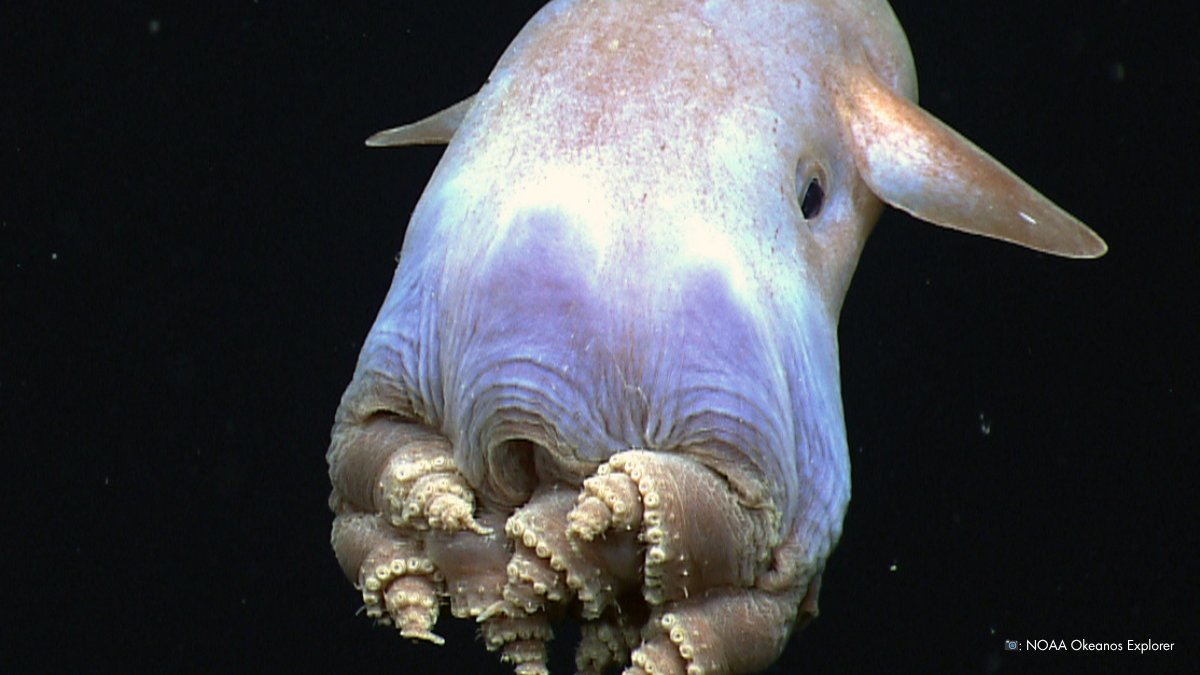
Not a cartoon. Not an alien. Just a survivor of the abyss.
The Dumbo octopus isn’t your average eight-legged cephalopod. It’s a finned drifter from the deepest parts of the ocean, belonging to a primitive, mysterious branch of the octopus family tree. First discovered in 1883, and still baffling scientists well into 2025, it thrives in pitch-black waters over 13,000 feet down—far beyond the reach of sunlight, and far beyond most human understanding.

Unlike its shallow-water cousins, the Dumbo octopus lacks an ink sac, ink sac, no chromatophores for color change, and no need for flashy displays. In the dark and crushing pressure of the deep sea, it doesn’t run or hide. It simply floats. Using its ear-like fins for propulsion and a webbed arm skirt for control, it moves with the grace of a ghostly ballerina. This isn’t about escape. It’s about surviving in a world where few things even bother to chase you.
Seventeen species of Dumbo octopus have been identified so far, from the North Atlantic to the Pacific and Southern Oceans. And more are still being found—like the Emperor Dumbo, discovered just a few years ago and studied without dissection using full-body MRI scans. The deeper we look, the more variations we see: different sucker counts, different fin spans, different strategies for hovering, crawling, or pouncing.

But the strangest part may be how they’re born. Dumbo octopus hatchlings don’t emerge helpless. They hatch fully formed, fins and all—ready to swim, hunt, and survive. Females lay large eggs on hard surfaces like deep-sea coral, then leave. No brooding. No protection. Just one shot at life, drifting off the edge of the world.
In terms of behavior, they’re patient hunters. No fast chases or ink-squirting theatrics. Instead, they hover. Wait. Use fine cirri—hair-like sensory strands near their suckers—to feel for crustaceans, worms, and mollusks. Then they pounce, enveloping prey with their webbed arms and swallowing it whole. No chewing. No time wasted.

They have no known predators. Not because they’re fierce, but because they live where almost nothing else does. Still, they’re not entirely safe. Deep-sea trawling, coral destruction, and proposed mining projects threaten the very habitats they rely on to lay their eggs. These aren’t just oddities of the deep. They’re indicators of ecosystem health. Silent reminders that even in the quietest corners of the ocean, life adapts, evolves, and, when left alone, flourishes.
And somehow, every time we catch one on camera, it still feels like a myth drifting out of the dark.




Leave a comment