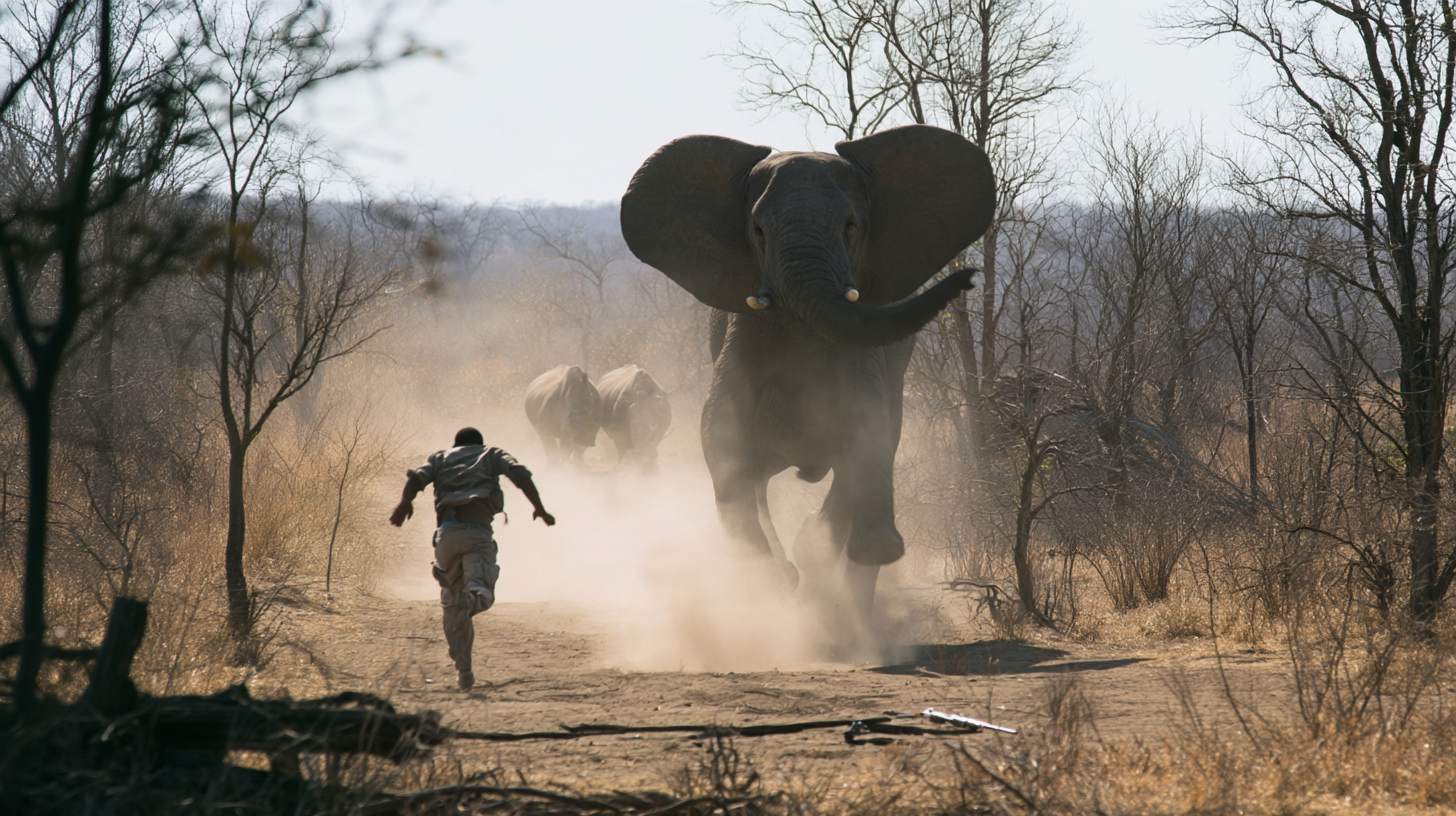
Elephants killed a suspected poacher in South Africa’s Kruger National Park after he and another man allegedly entered the park through Pafuri. His companion escaped, returned home and reported him missing. Rangers later found the man’s body and buffalo remains during their search.
Unlike fatal elephant encounters during licensed hunting safaris, this case involves suspected unlawful entry into a protected area. South African National Parks, or SANParks, says the surviving suspect acknowledged that entry after his arrest. The animal the men may have been hunting remains unclear.
Kruger communications general manager Rey Thakhuli later gave a firmer account of the death. “I can confirm that the suspect was trampled by a herd of elephants,” he told Letaba Herald in comments published on September 16.
The men allegedly entered Kruger on September 11, 2026. In its September 13 statement, SANParks said rangers were alerted the following day. Its preliminary account described the two men separating as they fled an elephant herd.
The man who escaped said he’d heard his companion scream. Local residents assisted with the arrest. The suspect then joined a team from Pafuri Ranger Post as it searched for his missing companion.
The search extended roughly six kilometers, or 3.7 miles, from the Luvuvhu River into Kruger. Rangers recovered the missing man’s body and also came across buffalo remains they believed were associated with illegal hunting.
SANParks hasn’t explained in its statement how the buffalo died or set out evidence linking its death to either suspect. It also makes no mention of a rhino.
A separate report citing an unnamed park source claimed the man was preparing to shoot a white rhino when elephants charged. Thakhuli’s confirmation establishes the trampling, but it doesn’t substantiate that account of an attempted shooting. Nor does the official statement describe elephants intervening to protect rhinos.

Kruger’s poaching problem extends beyond rhinos
The buffalo discovery draws attention to another part of Kruger’s wildlife crime problem. An Oxpeckers investigation published in 2024 documented buffalo being targeted by snare poachers, with elephants also caught in the traps.
Reporters described a commercial market for illegally hunted meat that went beyond household consumption. In northern Pafuri, however, a ranger also described people poaching for food amid severe economic hardship. Those differences are important because the circumstances of one incursion can’t automatically be assigned to another.
The park’s announcement provides no evidence that this buffalo was caught in a snare. Its remains nevertheless matter independently of the rhino claim.

Rhino losses, meanwhile, reveal how sharply conditions can differ within South Africa. Government figures released on February 10, 2026, recorded 352 rhinos poached nationwide during 2025, compared with 420 in 2024. Kruger moved in the opposite direction, with losses increasing from 88 to 175.
That amounts to a national decline of about 16%, set against an almost twofold increase within Kruger. A countrywide improvement can conceal a worsening problem inside a particular park. Those figures describe the full calendar year 2025, not losses recorded so far in 2026.
Some efforts to protect trafficked wildlife focus on reducing an animal’s value to poachers. Rhino dehorning applies that idea by removing much of the material a poacher would otherwise sell.

A 2025 study in Science used seven years of records, covering 2017 through 2023, from 11 Greater Kruger reserves. Researchers compared reserves with and without dehorning, alongside changes before and after its introduction. Their analysis associated dehorning with a 78% reduction in poaching.
Dehorning didn’t eliminate the danger. Some rhinos were still killed for the horn that remained or grew back. Researchers also cautioned that protecting dehorned animals in one area could shift poaching toward horned populations elsewhere.
In Pafuri, police investigative and forensic work continues. Community assistance helped bring the surviving suspect into custody, but the public record leaves the suspected hunt itself unresolved. What investigators establish about the buffalo’s death, and any connection to the men, could determine whether the remains are a clue to this incursion or a separate case of wildlife crime.

Leave a comment