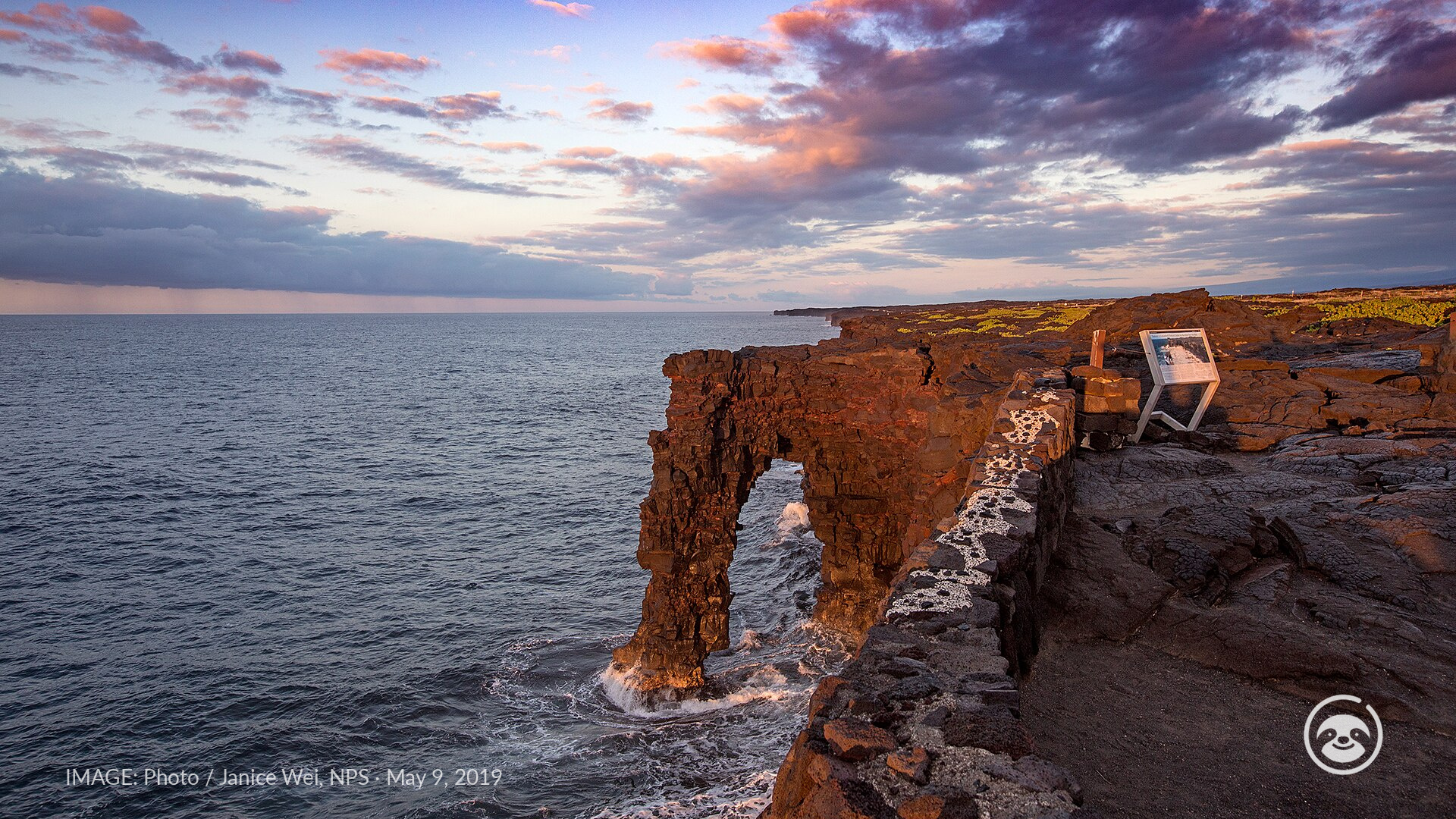
Hōlei Sea Arch has collapsed into the Pacific Ocean, removing the stone bridge that reached out from Hawaiʻi’s volcanic cliffs. The roughly 90-foot formation was a landmark of Hawaiʻi Volcanoes National Park, close to where Chain of Craters Road ends.
In a landscape shaped by Kīlauea’s eruptions and lava flows, Hōlei offered a view of what happens after the lava hardens. Waves had carved an opening through the coastal rock. They also kept wearing away the rock that held it up.
The National Park Service confirmed the collapse on October 1, 2026. The arch remained standing on September 23 and was gone by the night of September 27. Its exact collapse time is unknown.
The park had closed because of Tropical Storm Nolo. Officials say the arch may have fallen during that closure, but they haven’t established what caused the final break.
The signs of instability had already changed how visitors approached the site.
Earthquakes associated with Kīlauea’s 2018 eruption damaged nearby cliffs. In January 2020, fresh cracks led the park to rope off the original overlook and its access trail. Visitors could still travel down Chain of Craters Road, but they couldn’t use that stopping point.
By March 2020, visitors had a new viewing area set back from the edge. Then, in July 2022, large surf removed a chunk of the arch. Photographs taken on July 17 and 18 documented that earlier loss, when much of the formation still remained.
The overlook closure concerned the surrounding cliffs. The later surf damage showed that the arch itself was also losing material. Neither observation supplied a date for its disappearance.
How waves carved an arch out of lava
The lava came first. The park dates the flow containing Hōlei’s rock to roughly 550 years ago. That figure describes the material from which the arch developed. It doesn’t tell us precisely when waves opened the passage or when it acquired the shape seen in recent photographs.
Lava meeting the sea can extend a coastline. Once it cools, the exposed rock faces a different set of forces. Waves exploit cracks and remove less-resistant material, gradually hollowing sections of cliff. Where erosion opens a passage through a projecting stretch of rock, a bridge can remain overhead.
Geologists call the unequal wearing away of rock differential erosion. At Hōlei, the process removed weaker portions of the old lava while more resistant rock remained. The opening was evidence of how much material had already disappeared.
An arch doesn’t mark the end of that process. Water continues reaching the supports, and further erosion can reduce the rock holding up the bridge. The shape that makes a formation recognizable can persist even as parts of it wear away.
In a 2014 explanation of Hōlei, the U.S. Geological Survey described waves wearing at the arch’s pillar and ended with a plain prediction: “One day, it will be gone.”
That sentence didn’t identify a coming storm or predict a collapse date. It described erosion already underway. Knowing that the arch would eventually fail wasn’t the same as knowing which day it would fall.
When an arch loses its bridge, a detached pillar may remain. Elsewhere, formations such as Ireland’s Dún Briste sea stack offer a view of coastal rock standing offshore after the surrounding land has eroded. The rock that survives and the gaps around it both record the shoreline’s changes.
At Hōlei, the immediate concern is the cliff that remains. Park officials are warning visitors away from the edge and out of closed areas. The park says photographs circulating online show people entering the restricted area, exposing themselves and potential rescuers to falls and rough water.
The remaining cliffs are still subject to erosion. For visitors, the loss changes the view, not the danger of standing too close.

Leave a comment