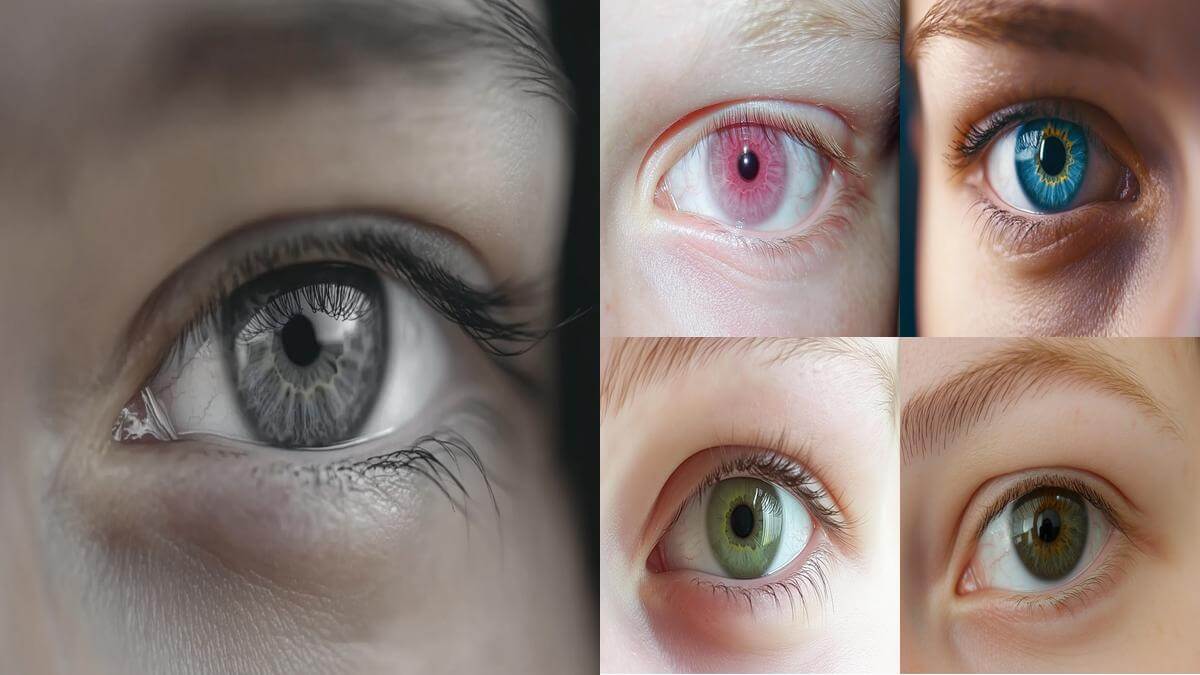
It’s often said that our eyes serve as windows to identity, ancestry, and even health. In a world of more than 8 billion people, the color of these windows forms a striking mosaic that spans continents, cultures, and climates. Some hues are prevalent, while others are so rare they seem almost mythical.
A Complex Inheritance
Eye color emerges from the interplay of genes that govern melanin production and distribution in the iris. Lower melanin levels result in lighter colors like blue, gray, or green, while higher melanin concentrations create the deep browns that are common in many parts of the globe. Scientists have identified a host of genes, including OCA2 and HERC2, that collectively influence the intensity and shade of one’s eyes.
Brown to Blue, a Shifting Majority


Brown eyes make up roughly 70 to 80% of the global population. This dominance is no surprise, given that early humans all had brown irises before mutations introduced lighter hues. Today, northern Europe hosts most of the world’s blue-eyed individuals, who account for around 8 to 10% of all people. Their distinctive shade results from an inherited mutation that lowers melanin levels, allowing the shorter wavelengths of light to reflect outward.
From the Uncommon to the Rare


Hazel and amber each claim about 5% of the global eye color distribution. Hazel appears when a moderate amount of melanin mixes with subtle scattering of light, sometimes creating different tones under varying conditions. Amber, by contrast, holds a steady golden or copper tint thanks to a higher concentration of a yellow pigment called lipochrome.
Gray eyes are even rarer, at about 3%, often revealing themselves in regions of Eastern Europe or parts of Central Asia. Green eyes, the scarcest in this family of natural hues, appear in only 2% of the global population and are commonly tied to Celtic and Germanic backgrounds.

A Look Beyond the Ordinary
Some conditions produce unusual eye colors, like red or violet, which can appear in individuals with albinism who lack enough melanin to mask underlying blood vessels. Heterochromia, affecting under 1% of people, involves either a difference in each eye’s color or a single iris that shows multiple shades.

Eyes as Health Indicators
Your iris can also hint at medical concerns. Lighter-colored eyes may be prone to macular degeneration or ocular melanoma, while certain inflammatory conditions can alter the sclera, giving a yellowish hue. Regular checkups, protective eyewear, and mindful observation help preserve vision and catch potential issues early.
From the common brown to the elusive green, each hue tells a story of lineage, adaptation, and chance. They remind us that within our shared humanity lies a spectrum of subtle differences, each shaped by ancient histories and ongoing genetic shifts.
| Eye Color | Global % | Key Regions & Notes |
|---|---|---|
| Brown | 70–80% | Most common worldwide, high melanin levels, prevalent in Africa, Asia, and the Middle East. |
| Blue | 8–10% | Common in Northern and Eastern Europe, linked to a genetic mutation reducing melanin. |
| Hazel | 5% | Blend of green, brown, and gold tones, found in the Middle East, North Africa, and parts of the Americas. |
| Amber | 5% | Solid yellow or gold hue due to higher lipochrome levels, seen in parts of Europe, Asia, and South America. |
| Gray | 3% | Distinct light iris with minimal melanin, more common in parts of Eastern Europe and Central Asia. |
| Green | 2% | Rarest natural color, influenced by Celtic and Germanic ancestry, found mostly in Northern and Central Europe. |
If you’re curious to learn more about how genetics shape not only our eye color but also our broader physical traits and health, here are a few books worth exploring:
Leave a comment