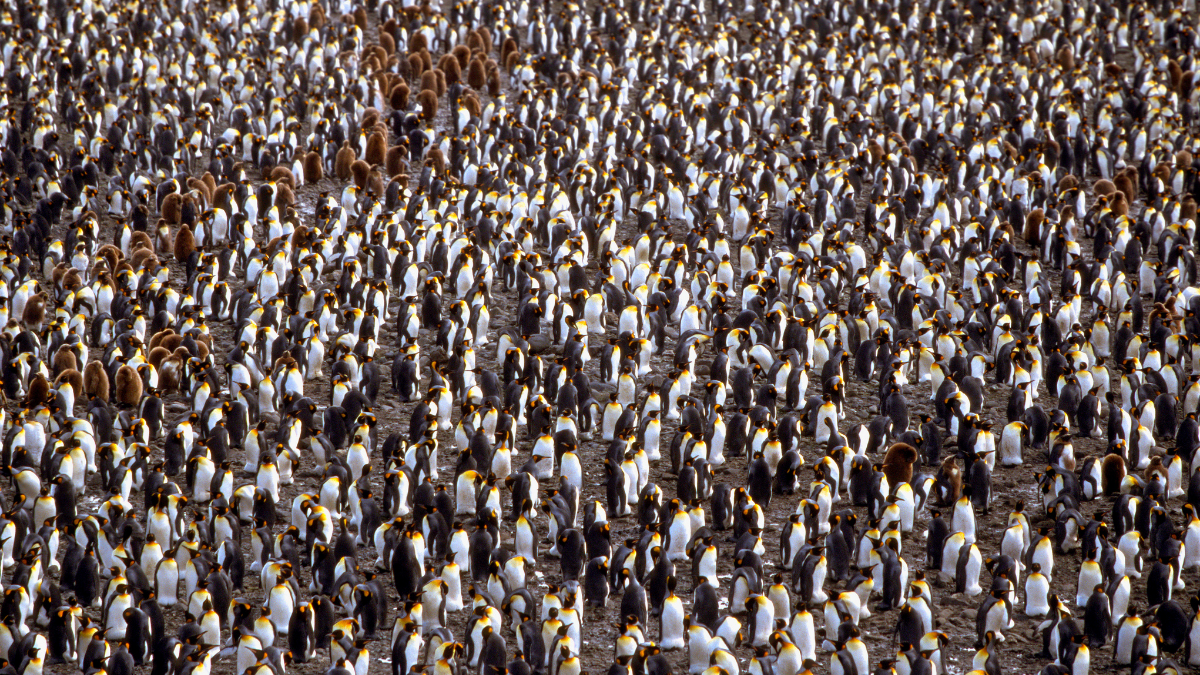
In early 2021, the world was transfixed by photos of a bright yellow king penguin. The penguin, photographed by Belgian wildlife photographer Yves Adams in December 2019 on South Georgia Island, was unlike any king penguin ever documented. Its golden coat made it stand out instantly, a reminder that even in vast colonies, nature sometimes paints outside the lines.
A penguin painted by genetics
The unusual coloration stems from a genetic condition known as leucism, which causes partial loss of pigmentation. Unlike albinism, where melanin is completely absent and animals appear white with pink or red eyes, leucistic animals still produce some pigment. They often retain normal eye and skin color, while their fur or feathers turn pale or patchy.
In penguins, melanin normally darkens the back and flippers, adding strength to feathers while also providing camouflage in the water. Scientists believe Adams’ penguin could not deposit melanin into its feathers, leaving only the natural yellow pigments, molecules called spheniscin unique to penguins, visible across its body. The result was a lemon-colored bird in a sea of black and white. Ornithologists have suggested the mutation may be sex-linked, meaning it could more readily appear in females.
Such pigment mutations are extremely rare. Adams called the odds of seeing another yellow penguin “one in a million.” With an estimated 4 to 5 million king penguins worldwide, the South Georgia bird may truly be one of a kind.
South Georgia is a remote, glacier-covered island in the South Atlantic, about 800 miles east of the Falklands. Despite its harsh climate, it remains one of the world’s great wildlife sanctuaries.
Rich surrounding waters sustain immense colonies of seabirds and seals. At St. Andrews Bay, more than 150,000 king penguin pairs gather each year. Salisbury Plain, where Adams encountered the yellow penguin, supports around 120,000. Other species, including macaroni and gentoo penguins, also nest here. In total, about 100 million seabirds breed on the island annually. Its beaches host hundreds of thousands of elephant seals and nearly the entire global population of Antarctic fur seals.
The recovery of South Georgia’s ecosystem did not happen by chance. Decades of conservation have reversed much of the damage caused by sealing, whaling, and invasive species. A landmark 2018 eradication program successfully cleared rats from the island, allowing endemic birds to rebound naturally. With predators gone, ground-nesting birds like the South Georgia pipit and pintail duck are thriving again.
Today, the most pressing threat is climate change. Warming seas are pushing penguins’ feeding grounds farther away, and studies warn that many colonies could decline sharply by the end of the century.
A once-in-a-lifetime encounter
Penguin coloration is more than decoration. The dark back blends with the depths when viewed from above, while the white belly hides them against light from the surface. Melanin also strengthens feathers, making them more durable. Without it, feathers may fray faster and force more frequent molts.
A golden penguin might also be easier for predators like leopard seals to spot. Still, many leucistic birds live normal lives. Colonies do not appear to reject them, and some even breed successfully. In king penguins, where bright yellow and orange patches play a role in courtship, an all-yellow coat could even prove attractive.
Adams was just two days into a two-month expedition when he landed at Salisbury Plain. While unloading gear among thousands of penguins, he noticed a bird swimming in that looked different. “One of the birds looked really strange, and when I looked closer, it was yellow,” he told Smithsonian Magazine.
The bird, a curious juvenile, waddled up onto the beach near him. For a few minutes, Adams and his team had a clear, close view before it slipped into the massive colony. “It was heaven that he landed by us. If it had been 50 metres away, we wouldn’t have been able to get this show of a lifetime,” Adams told The Independent.
When he released the images in 2021, they spread quickly worldwide. The “golden penguin” became a viral phenomenon, and Adams reflected that he felt incredibly fortunate to witness it. For him, it was truly the photograph of a lifetime.
The yellow king penguin also joins a list of rare pigment variations in the wild. In 2019, a brown king penguin was seen on South Georgia, its dark feathers replaced by chocolate hues. In 2012, tourists spotted a pure white chinstrap penguin in Antarctica. Other animals have become famous for unusual colors too: bright yellow northern cardinals in the United States, leucistic white giraffes in Kenya, and Migaloo, the albino humpback whale off Australia. Each case has drawn both scientific curiosity and public wonder.
These anomalies highlight the role of genetics in shaping biodiversity, while reminding us how a single unusual individual can capture global imagination.
Leave a comment