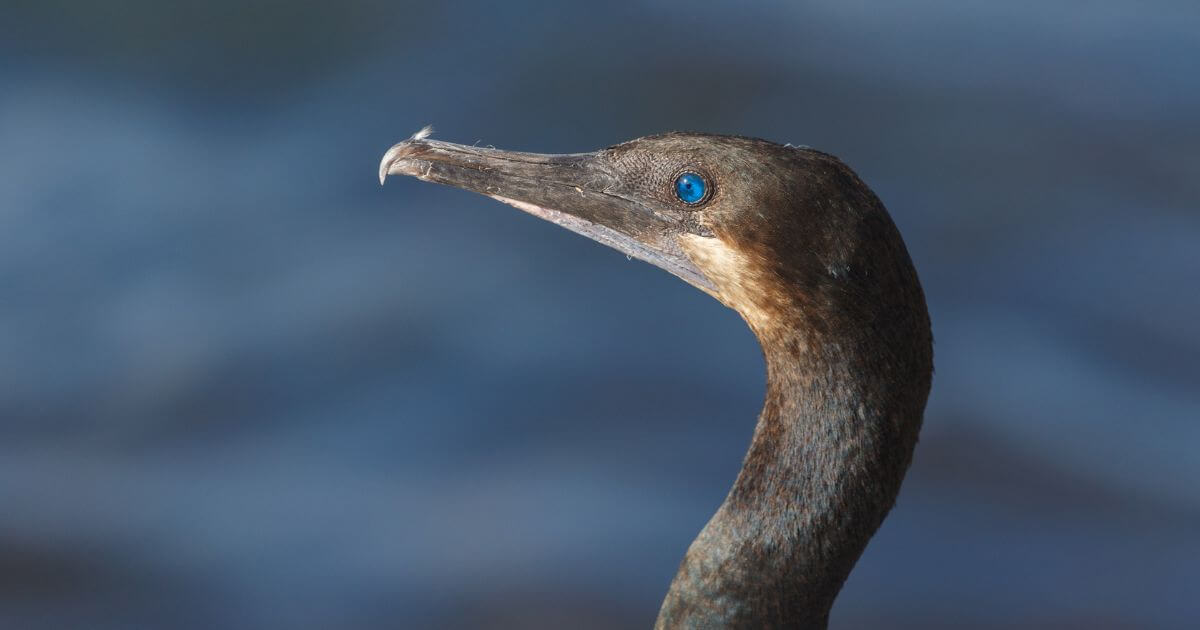
The Brandt’s Cormorant, a marine bird found along the Pacific coast of North America, is notable for its distinctive appearance during the breeding season.
This species of cormorant is easily recognized by its vivid cobalt-blue throat patch and eyes, which stand out against its predominantly black plumage. This striking feature not only serves as a key identifier but also plays a crucial role in their breeding rituals.
The change in the eye color of the Brandt’s Cormorant to a deep blue is accompanied by the development of wispy white feathers on the head, adding to its ornate breeding display. Juveniles and non-breeding adults, however, present a more subdued appearance with brownish or grayish tones. Navigating their habitat, these birds exhibit remarkable diving skills, plunging into the ocean depths to hunt for fish.
The blue eye color is at peak vibrancy during the breeding season and is thought to play a role in attracting a mate. After the breeding season, the brightness of the eyes fades. The eyes are a window into the health and vitality of the Brandt’s Cormorant, showcasing its adaptability and resilience as it thrives in the California Current, its primary feeding ground.
Physical Characteristics of the Brandt’s Cormorant
The Brandt’s Cormorant exhibits distinctive physical features, especially during the breeding season, with variations in feather coloration and unique eye characteristics that set it apart from other seabirds.

Feather Plumage and Coloration
Brandt’s Cormorants possess a primarily dark plumage with nuances that become more pronounced during the breeding season. In breeding plumage, adults display a vivid cobalt-blue throat patch and can also be identified by wispy white feathers that may appear on their heads. Outside of breeding season, their feathering is generally a more consistent black hue throughout.
Eye Features and Vision
One of the most striking features of the Brandt’s Cormorant during the breeding season is its deep-blue eye color. These seabirds have excellent underwater vision, which is crucial for their diving behavior as they hunt for fish and shellfish. Their eyes are adapted to the varying light conditions of their marine environment.
Size and Weight
The Brandt’s Cormorant is a moderately large seabird. On average, these birds can weigh between 2 to 2.5 kilograms (4.4 to 5.5 pounds), with a body length ranging from 75 to 85 centimeters (29.5 to 33.5 inches). The males are generally larger than the females and exhibit a slightly more robust stature.

Behavior and Ecology
The behavior and ecology of Brandt’s Cormorant are defined by its expert diving skills and communal nesting habits, shaped by the rich marine environments they inhabit.
Feeding Habits
Brandt’s Cormorants are efficient divers, reaching depths over 70 meters. They primarily feed on fish and shellfish, hunting in the productive waters of the California Current. Their diving is propelled by powerful webbed feet, and they can stay submerged for significant periods.
Breeding and Nesting
During the breeding season, Brandt’s Cormorants are identifiable by their distinctive vivid cobalt-blue throat patch and eyes. They nest in dense colonies on cliffs and rocky outcrops near the shore. Nesting and foraging occur in areas with abundant marine life, facilitating the feeding of chicks.

Migration Patterns
These birds exhibit partial migratory behavior, moving in response to changes in food availability and environmental conditions. Their migrations keep them largely over water, following the coastline rather than crossing land. The particulars of their migratory patterns are influenced by the oceanographic features of their habitats.


Leave a comment