Moths often live in the shadow of their showier butterfly cousins, but these nocturnal (and sometimes diurnal!) flyers deserve their own spotlight. With over 160,000 species worldwide, moths come in stunning sizes, colors, and patterns. Below, we highlight 20 of the most beautiful moth species, each uniquely captivating and crucial to the ecosystems they inhabit.

Quick Navigation
Understanding Moth Diversity Role of Moths in Ecosystems Further Reading Conclusion
1) Luna Moth

- Key Features: Pale green wings with long tails, translucent eyespots.
- Wingspan: Up to 4.5 inches.
- Habitat: North America (wooded areas).
- Fun Fact: Adults don’t have mouthparts; they live only about a week, focusing solely on mating and laying eggs.
Seeing a Luna Moth feels almost mystical, especially at night when its pale green color seems to glow in the moonlight.
2) Atlas Moth

- Key Features: One of the largest moths on Earth, with wings shaped like a snake’s head at the tips.
- Wingspan: Up to 12 inches.
- Habitat: Tropical forests of Asia (India, Indonesia, etc.).
- Fun Fact: Adults do not eat; they rely on fat reserves from their caterpillar stage.
Its massive wings and rich reddish-brown patterns are instantly mesmerizing. The “snake head” wing tips help deter predators.
3) Emperor Moth

- Key Features: Large, colorful wings with prominent eyespots.
- Wingspan: About 2-3 inches.
- Habitat: Europe and parts of Africa; thrives in woodlands and moorlands.
- Fun Fact: Males have feathery antennae to detect female pheromones over long distances.
The Emperor Moth’s bold eyespots help deter predators by imitating the eyes of larger animals.
4) Cecropia Moth

- Key Features: Reddish-brown wings with white bands and dramatic eyespots.
- Wingspan: Up to 6 inches (North America’s largest moth).
- Habitat: Forests and wooded areas in the eastern U.S. and Canada.
- Fun Fact: Caterpillars can be quite colorful with bright tubercles.
One of the “giant silk moths,” the Cecropia is a night flyer that relies on pheromones for mate-finding.
5) Io Moth (Peacock Moth)

- Key Features: Vibrant eye-like spots on hindwings used to scare predators.
- Wingspan: 2.5 to 3.5 inches.
- Habitat: Widespread in North America, especially near woods and fields.
- Fun Fact: Caterpillars have spines that can irritate human skin.
Males are typically bright yellow, while females are more brownish. A quick flash of their eyespots can surprise would-be attackers.
6) Polyphemus Moth

- Key Features: Large eyespots on hindwings resembling owl eyes.
- Wingspan: Up to 6 inches.
- Habitat: North America; found in deciduous forests and near urban lights.
- Fun Fact: Named after the giant Polyphemus from Greek mythology.
Their camouflage is excellent, but when threatened, they flash the big “owl eye” spots to confuse predators.
7) Rosy Maple Moth

- Key Features: Candy-like pink and yellow coloration.
- Wingspan: 1.25 to 2 inches.
- Habitat: North America, commonly near maple trees.
- Fun Fact: One of the smallest silkmoths, but arguably one of the most eye-catching.
These playful-looking moths quickly grab attention with their whimsical hues.
8) White Witch Moth

- Key Features: Among the longest wingspans in the moth world, up to ~12 inches.
- Habitat: Central and South America, especially in tropical rainforests.
- Fun Fact: Intricate patterns of white, gray, and black help it blend into tree bark.
Seeing one in flight at night is an unforgettable experience due to its massive, ghostly wings.
9) Hummingbird Hawk-Moth

- Key Features: Can hover like a hummingbird while feeding on nectar.
- Wingspan: ~1.5 to 2 inches.
- Habitat: Europe, Asia, North Africa; prefers warm climates.
- Fun Fact: Has a very long proboscis adapted for deep flowers.
One of the few diurnal moths, often mistaken for an actual hummingbird due to its flight style.
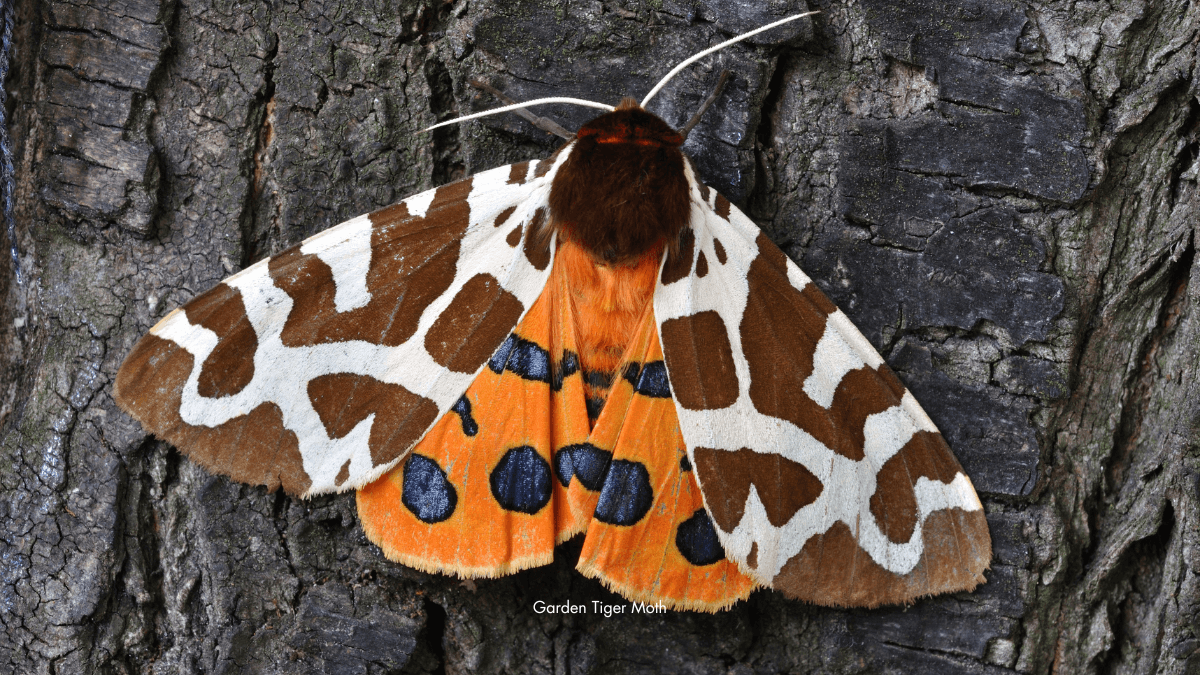
10) Garden Tiger Moth

- Key Features: Forewings have dark brown patches; hindwings are bright orange-red with black spots.
- Wingspan: About 2 inches.
- Habitat: Europe, also found in North America; commonly near gardens and meadows.
- Fun Fact: Fuzzy caterpillars (woolly bears) are often seen wandering around in search of food.
Once common in parts of the UK, its population has declined—highlighting the importance of habitat conservation.
11) Comet Moth

- Key Features: Bright yellow wings with extremely long tail extensions.
- Wingspan: ~20 cm; tail can be even longer.
- Habitat: Endemic to the rainforests of Madagascar.
- Fun Fact: Adults have no mouthparts and live only a few days.
Its vibrant coloration and tail “streamers” make this species a must-see in Madagascar’s biodiversity hotspots.
12) Madagascan Sunset Moth

- Key Features: Day-flying with iridescent, rainbow-colored wings.
- Wingspan: Up to ~4 inches.
- Habitat: Found only in Madagascar.
- Fun Fact: Not poisonous, but bright colors can trick predators into thinking otherwise.
These kaleidoscopic wings are formed by microscopic scales that refract light, creating a dazzling display.
13) Venezuelan Poodle Moth

- Key Features: Fluffy fur-like scales, giving it a “poodle” appearance.
- Wingspan: Not fully documented; discovered in 2009.
- Habitat: Venezuela; specifics are still under study.
- Fun Fact: Its unique look went viral online shortly after its discovery, sparking debate over authenticity.
Still poorly understood, its ghostly fuzziness has made it an internet sensation among insect enthusiasts.
14) Spanish Moon Moth

- Key Features: Pale green wings with wavy edges; an almost translucent appearance.
- Wingspan: Up to ~3 inches.
- Habitat: Mountainous regions in Spain (pine forests).
- Fun Fact: Protected species due to habitat specificity and rarity.
Its delicate wings look like living art, cherished by entomologists and collectors alike.
15) Twin-Spotted Sphinx Moth

- Key Features: Brownish forewings with two distinct eyespots on each hindwing.
- Wingspan: ~2.5 to 3.5 inches.
- Habitat: Widespread in North America, found in wooded areas.
- Fun Fact: Adults often have a reduced or absent proboscis, so they do not feed.
Its larvae (hornworms) feed voraciously on leaves, sometimes causing alarm for gardeners—but they’re harmless overall.
16) Oleander Hawk-Moth

- Key Features: Green camouflage with pink-white streaks, making it blend perfectly with foliage.
- Wingspan: 3.5 to 5 inches.
- Habitat: Africa, Asia, and parts of the Mediterranean.
- Fun Fact: Caterpillars feed on toxic oleander leaves without harm, incorporating defensive compounds into their bodies.
Swift in flight, the Oleander Hawk-Moth is a twilight pollinator that’s surprisingly easy to spot due to its bright colors.
17) Elephant Hawk-Moth

- Key Features: Pink-and-olive forewings; strikingly vivid color combination.
- Wingspan: 2.4 to 3.1 inches.
- Habitat: Europe and Asia; gardens, woodlands, meadows.
- Fun Fact: The caterpillar’s enlarged thorax resembles an elephant’s trunk, giving the species its name.
They’re active at night but occasionally seen feeding at dusk on honeysuckle and other fragrant flowers.
18) Chinese Moon Moth

- Key Features: Bright green wings with delicate tails and bold eyespots.
- Wingspan: Up to 6 inches.
- Habitat: Forested regions of China; part of the Saturniidae family.
- Fun Fact: Caterpillars feed on walnut and alder leaves.
Sometimes kept by hobbyists for their stunning display, they’re a highlight of Asian forest fauna.
19) Giant Leopard Moth

- Key Features: Bright white wings with bold black spots resembling a leopard’s coat.
- Wingspan: About 3 inches.
- Habitat: Eastern U.S. and into parts of Mexico.
- Fun Fact: The iridescent abdomen can display bluish or orange hues when exposed.
Its “woolly bear” caterpillar stage is a common sight, covered in stiff black hairs with red inter-segments.
20) Cherry Spot Caterpillar Moth

- Key Features: Adults have a subdued color palette but distinct wing markings.
- Habitat: Frequently found near cherry trees (the caterpillars’ main food source).
- Fun Fact: Their patterns help them blend into bark and leaves, offering excellent camouflage.
This understated moth still contributes to biodiversity, providing a food source for birds and other predators.
Understanding Moth Diversity
Moths outnumber butterfly species significantly, showcasing a remarkable array of adaptations. They inhabit virtually every ecosystem on Earth except Antarctica. Their scale-covered wings produce vivid hues (or perfect camouflage!), and many have feathery antennae tuned to detect pheromones.
Key Characteristics
- Scales on Wings: Responsible for the wide range of colors and patterns.
- Mostly Nocturnal: Many fly at night, though there are striking day-flying species (like the Hummingbird Hawk-Moth).
- Essential Pollinators: Using coiled proboscises to drink nectar, some moths pollinate night-blooming flowers.
- Lifecycle: Egg → Caterpillar (larva) → Pupa → Adult moth.
Habitats Around the World
From the dense tropical rainforests (Madagascan Sunset Moth) to temperate woodlands (Polyphemus, Cecropia, Rosy Maple), moths adapt to local climates, host plants, and predator threats. In urban areas, you’ll often find them around porch lights (though light pollution can disrupt their behaviors).
Role of Moths in Ecosystems
Pollinators and Their Importance
Many moths are crucial nighttime pollinators, ensuring the reproduction of plants that bloom or emit fragrance at dusk. This helps maintain floral diversity and supports farmers with cross-pollination of certain crops.
Moths as Food Sources
They’re also a key link in the food web—birds, bats, and other animals rely on moths (and their caterpillars) for nourishment. When caterpillars are abundant, it supports healthier populations of insectivorous species.
Further Reading
Expand your knowledge on moths and their caterpillars with these top-rated books:
- “Caterpillars of Eastern North America” by David L. Wagner
View on Amazon
A detailed field guide with photos and life cycle info on caterpillars that become many of these stunning moths. - “Moths: A Complete Guide to Biology and Behavior” by David Lees & Alberto Zilli
View on Amazon
Explores moth evolution, habitats, and fascinating nocturnal behaviors. - “Butterflies and Moths (A Golden Guide)” by Robert T. Mitchell
View on Amazon
A classic, pocket-sized guide—great for beginners and children. - “National Audubon Society Field Guide to North American Insects & Spiders”
View on Amazon
Not solely about moths but an excellent, comprehensive reference for all insect life.
(Disclaimer: As an Amazon Associate, we earn from qualifying purchases.)
Conclusion
From the candy-colored Rosy Maple Moth to the colossal Atlas Moth, these 20 species demonstrate the extraordinary artistry of nature’s nighttime (and sometimes daytime) flyers. Whether you spot one in your backyard or dream of traveling to Madagascar to see a Comet Moth, moths can spark awe and appreciation for the delicate balance they maintain in their ecosystems.
What’s your favorite moth from this list?
Let us know in the comments, and don’t forget to share this post with fellow moth lovers. If you’re eager to learn more, explore one of the recommended books above for a deeper dive into the captivating world of moths.
Leave a comment