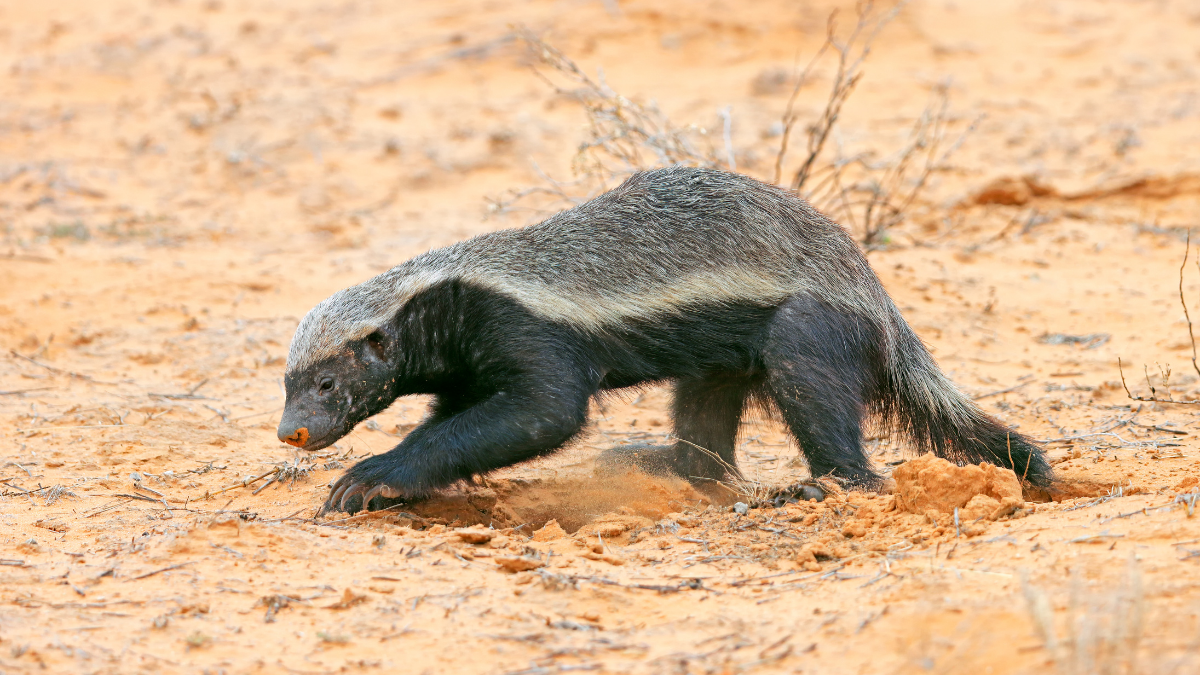
The honey badger (Mellivora capensis) is proof that size doesn’t always dictate power. Weighing no more than a small dog, it has earned a reputation across Africa and parts of Asia as one of the toughest animals alive. The Guinness Book of World Records even once declared it “the most fearless animal in the world.”

Its resilience is rooted in extraordinary biology. Honey badgers have thick, loose skin, up to 6 mm around the neck, that’s difficult to pierce and allows them to twist inside their own hide to bite attackers. This unique armor shields them from thorns, bites, and stings in the dense bush.
They’re resistant to some of the world’s deadliest snake venoms, thanks to mutations in their cell receptors. A cobra bite might knock one unconscious for hours, only for it to wake, shake itself off, and resume eating the snake. Scientists believe this adaptation evolved from generations of hunting venomous reptiles, giving the honey badger an evolutionary edge few mammals possess.
Their claws are long, sharp, and powerful, ideal for digging out burrowing prey, ripping into termite mounds, or breaking into beehives. A bite strong enough to crack tortoise shells adds to their arsenal, as do scent glands capable of releasing a foul secretion that deters even lions.
In dry regions, those same claws help them dig for roots and tubers when other food is scarce, ensuring they can survive even in the harshest droughts.

Fearlessness backed by intelligence
Honey badgers are remarkably intelligent. In captivity, individuals have been filmed stacking logs to climb out of enclosures, opening latches, and even using tools to access food. The most famous example, Stoffel from a South African wildlife center, escaped multiple times by manipulating locks and moving objects into position.
In the wild, they raid campsites by unlatching cooler boxes, tearing open tents, or knocking over garbage bins. This adaptability allows them to survive in deserts, savannas, forests, and high mountain plateaus. Field guides often describe them as “thinking predators” — able to assess a situation and find creative solutions.
Diet-wise, honey badgers are fearless omnivores. They eat venomous snakes, bird eggs, small mammals, insects, carrion, fruits, and roots. Their name comes from their willingness to endure hundreds of bee stings to raid hives for honey and larvae.
Observers have seen them return to a hive repeatedly, undeterred by swarms. Some communities report rare partnerships with the greater honeyguide bird, which may lead them to beehives in exchange for leftover wax, though such cooperation remains debated among scientists.

When threatened, honey badgers don’t flee. They charge, growling and snapping at much larger predators like lions, leopards, and hyenas. Their stance is low and aggressive, fur bristling, as they lunge toward an opponent’s face. This aggressive defense, paired with their chemical spray and impenetrable hide, often convinces attackers to back off.
There are accounts of badgers holding their ground against entire prides of lions, sometimes escaping with little more than scratches. They’ve been documented dragging prey many times their size and confronting threats that most animals would avoid entirely.
Ecologically, they control rodent and insect populations, disperse seeds, and aerate soil through constant digging. Their abandoned burrows become homes for other animals, from warthogs to jackals.
By preying on venomous snakes, they may even reduce risks for other wildlife and local people. Their role as both predator and scavenger ensures that resources are cycled efficiently through their ecosystems.
Despite their adaptability, honey badgers face threats from humans — especially beekeepers and farmers who kill them to protect hives and poultry. In some regions, they’re hunted for traditional medicine or trophies.
Conservationists now promote “badger-friendly” honey, with hives raised on tall stands out of reach. In some countries, like Israel, they’re legally protected, and awareness campaigns are helping shift perceptions from pest to valuable predator. Education efforts emphasize their role in pest control and ecosystem health.
In African folklore, honey badgers symbolize courage, cunning, and persistence. Tales portray them as clever tricksters and relentless fighters. Globally, their legend grew after the viral “Honey badger don’t care” video, cementing their status as the internet’s ultimate maverick.
Small in size but unmatched in spirit, the honey badger is a living reminder that evolution can arm even the most unassuming creature with the means to thrive in a dangerous world — and inspire respect far beyond its modest stature.


Leave a comment