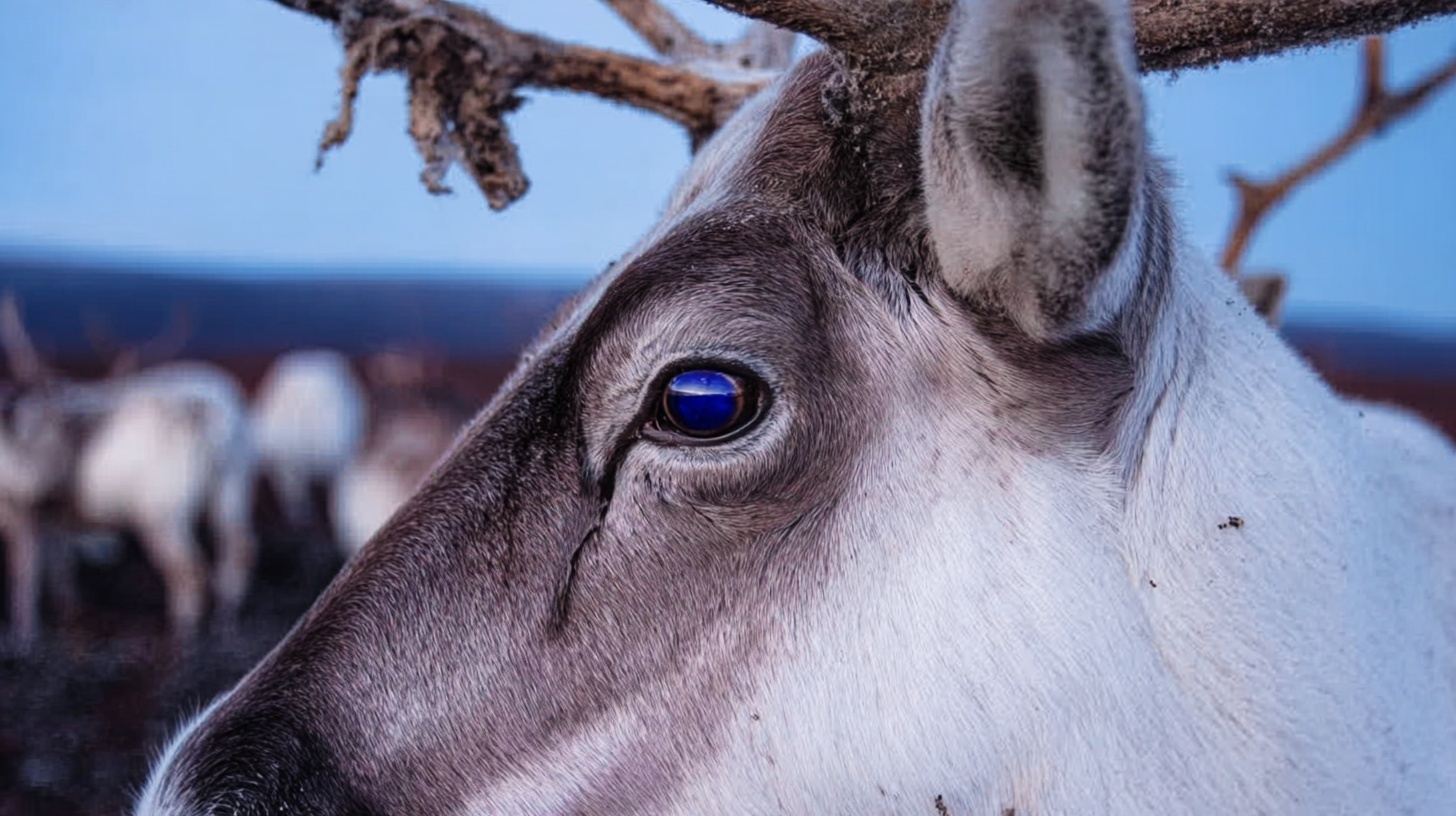
In the Arctic, where sunlight disappears for weeks on end, reindeer eyes undergo a transformation unlike anything else in the animal kingdom. As winter sets in and darkness swallows the tundra, their eyes shift from a warm, golden glow to an eerie, electric blue.
It’s not a trick of the light or a seasonal pigment change. Scientists say it’s a physical remodeling of the eye’s reflective layer, the tapetum lucidum, that tunes the animal’s vision for survival in one of the planet’s most extreme environments. This phenomenon was first detailed in a 2013 study published in the Proceedings of the Royal Society B, which found that pressure changes in the eye cause the tapetum to shift from gold to blue in winter (Jeffery et al., 2013).

How reindeer eyes adapt to Arctic darkness
The tapetum, found in many nocturnal animals, helps bounce light back through the retina. But in reindeer, that layer doesn’t just reflect light, it adapts to it. In summer, loose collagen fibers reflect yellow-gold light. Come winter, months of dilated pupils raise pressure in the eye, squeezing those fibers tighter and shifting reflectance to the blue end of the spectrum. This change makes reindeer eyes up to a thousand times more sensitive in the dark.
That comes with a trade-off. The same scattering that boosts sensitivity also blurs images slightly. But in a twilight world filled with snowdrifts, predators, and lichen-covered ground, the blur is worth the gain.
“It’s like flipping their eyes into night-vision mode,” said one researcher. And it’s not just the color shift that helps. Reindeer also see ultraviolet light, a spectrum invisible to humans. Snow reflects UV intensely, while predators and food sources like lichen absorb it, creating sharp visual contrasts that only the reindeer can detect.
That kind of perception isn’t just useful. It’s vital.

But as climate change and human development push deeper into the Arctic, this natural system faces disruption. Artificial light pollution could interfere with the eye’s ability to fully shift into winter mode. In areas near power lines or outposts, researchers have observed reindeer with a strange greenish eye, stuck halfway between summer and winter.
That twilight-blue glow, it turns out, depends on darkness.
What’s more, those glowing bands of power lines might look harmless to us, but reindeer see them in a different light. To their UV-sensitive eyes, high-voltage lines appear as shimmering arcs in the sky. Some herds avoid them entirely, shifting migratory paths and feeding zones as a result.
Still, the reindeer eye remains a marvel of seasonal engineering. Its dynamic design is now inspiring biomimicry research into adaptive optics and color-shifting materials. Think pressure-responsive sensors or smart coatings that adjust to light like reindeer vision does to Arctic night.
In a landscape of extremes, evolution has crafted a solution that shifts with the seasons. Gold for the endless sun. Blue for the eternal night.
Leave a comment