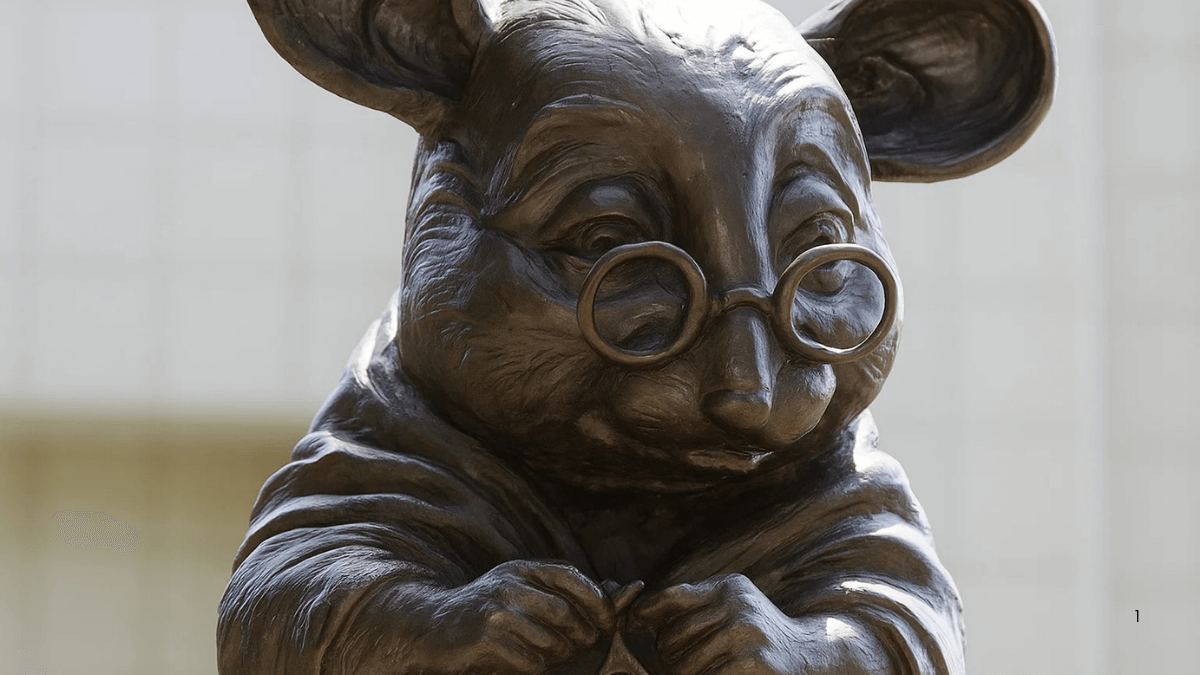
In the Siberian research city of Akademgorodok, a bronze statue stands in quiet defiance of its size. It is just a mouse—but not an ordinary one.
Wearing tiny pince-nez glasses and holding a pair of knitting needles, this mouse sits poised in thought, weaving a strand of DNA. The sculpture, titled “Monument to the Laboratory Mouse,” was unveiled in 2013 outside the Institute of Cytology and Genetics in Novosibirsk.
At first glance, it might strike visitors as whimsical. But this knitted helix tells a deeper story—one not just of science, but of sacrifice.
The statue honors the millions of mice that have died in the name of scientific progress. Biomedical breakthroughs, from cancer treatments to vaccines, have often come at the expense of small, unseen lives.
The mouse, perched on its granite pedestal, represents them all. And while the knitting motif softens the story—a grandmotherly gesture of patience and care—the message is not quaint.
This isn’t a celebration of cuteness. It’s a reckoning, cast in bronze.
The choice to depict the mouse as a scientist, knitting strands of life, turns a laboratory subject into a collaborator in the process of discovery. It suggests a shared labor between human and animal, intellect and instinct, researcher and subject.
The knitted DNA spirals to the left—forming Z-DNA, a less common and still-mysterious shape—hinting at the many unanswered questions still within our genetic code. That twist, according to the sculptor, points toward the unknowns of future research.
When science remembers its smallest subjects
Equally striking is how the mouse is portrayed: not as a victim, nor as a mere test subject, but as a participant. Sculptor Andrei Kharkevich intentionally blended the imagery of scientist and subject.
“They are connected and serve one cause,” he said. “If you look closely at its gaze, you can see that this mouse has already come up with something.”
This depiction walks a fine line between empathy and fantasy. On one hand, it honors the role these animals have played in shaping modern medicine.
On the other, it risks romanticizing the often harsh reality of animal testing. The mouse, after all, did not choose its role.
Yet here it is, imagined as a thoughtful academic, gently threading life’s blueprint through bronze needles.
Not everyone finds comfort in that image. Animal ethicists have criticized the statue as a veneer.
Trudi Bruges, writing for Crip HumAnimal, calls it an emotional buffer: a way for scientists to soothe the guilt of necessary harm.
Others argue the monument reimagines lab animals as willing collaborators, when in truth they have no say in their fate.
To them, the monument offers absolution, not accountability.
Still, it’s rare to see lab animals acknowledged at all. That this statue exists—funded by scientists, not activists—is significant.
This isn’t the only tribute of its kind. Similar monuments exist around the world: a bronze baboon in Sukhumi, a somber dog in Grodno, a mother-pup duo in Ufa, and of course, Laika the cosmonaut mutt in Moscow.
Each captures a different tone—some solemn, others defiant. But the knitting mouse stands apart.
Its design disarms. It draws you in.
And then, it quietly asks you to consider the invisible labor behind every pill bottle, every vaccine, every surgical technique.
It also evokes broader cultural questions. In Japan, memorial services for lab animals are held regularly, blending science and spirituality.
In London, the Brown Dog Memorial commemorates not collaboration, but protest against cruelty. Compared to these, Novosibirsk’s mouse sits at a gentler intersection: acknowledging the sacrifice, while still operating within the machinery of science.


Leave a comment