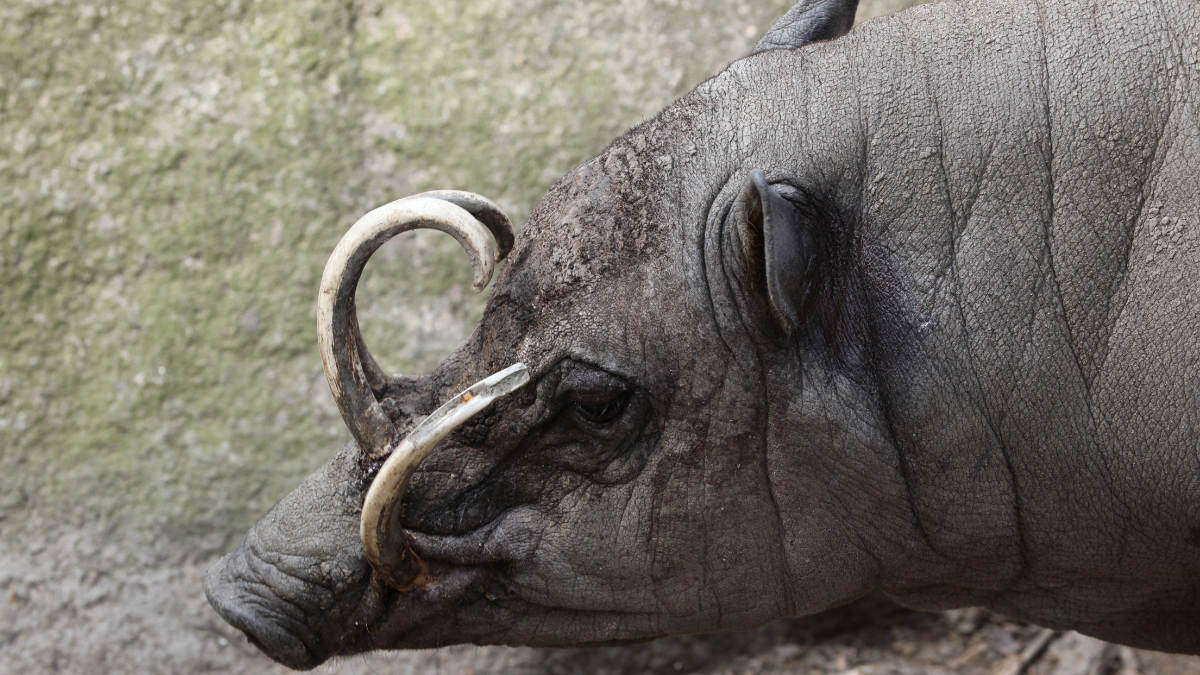
You’re looking at the babirusa, one of evolution’s strangest survivors. Found only on the Indonesian islands of Sulawesi, Buru, and a few nearby outposts, this “deer-pig” belongs to a lineage that split from other pigs over 10 million years ago. What sets it apart is obvious at first glance: its tusks.
In male babirusas, the upper canines don’t just grow out of the mouth like in warthogs. Instead, they erupt straight through the top of the snout and curl backward, sometimes in full loops toward the animal’s forehead. If not worn down or broken, they can grow long enough to press into the skull.

These tusks are brittle and not particularly suited for fighting. Scientists believe they serve more as display structures, a kind of biological crown used in mating rituals. Think of them less like weapons and more like peacock feathers or a lion’s mane.
Babirusas live in tropical forests near rivers and swamps. They’re excellent swimmers and surprisingly fast on land. Their diet is eclectic. Fruits, leaves, fungi, small animals, and even the occasional fish or carrion make it onto the menu. Unlike other pigs, they don’t root through soil with their snouts. Instead, they use their hooves to dig or browse directly from bushes.

Socially, males are loners. Females and young form small groups, and sometimes several of these will gather at mineral-rich mud wallows called salt licks. These licks aren’t just nutritional goldmines, they’re also social hubs. Researchers have observed gatherings of over 40 babirusas in places like the Nantu Reserve in Sulawesi.
Reproduction is slow for a pig. Gestation lasts about five to six months, and litters usually contain just one or two piglets. Females only have one pair of teats, a clue that this is the norm, not the exception. Young babirusas stay with their mothers for months and learn foraging skills by following her lead.
Today, all babirusa species are threatened. Habitat loss from logging and agriculture, along with illegal hunting, has reduced their numbers dramatically. On Buru Island, they’re considered endangered. In Sulawesi, conservation areas like the Nantu Reserve have helped protect remaining populations. There, local organizations run anti-poaching patrols, remove snares, and engage in community education.

Culturally, the babirusa has left deep marks. A cave painting in Sulawesi estimated to be over 35,000 years old shows a female babirusa, one of the earliest known depictions of any animal by humans. Locally, stories abound of babirusas sleeping with their tusks hooked on tree branches—a myth, but one that reveals just how curious and iconic these animals have always been.
Ancient, bizarre, and endangered, the babirusa reminds us how much evolutionary diversity the world still holds, and how much of it we’re at risk of losing.
Leave a comment