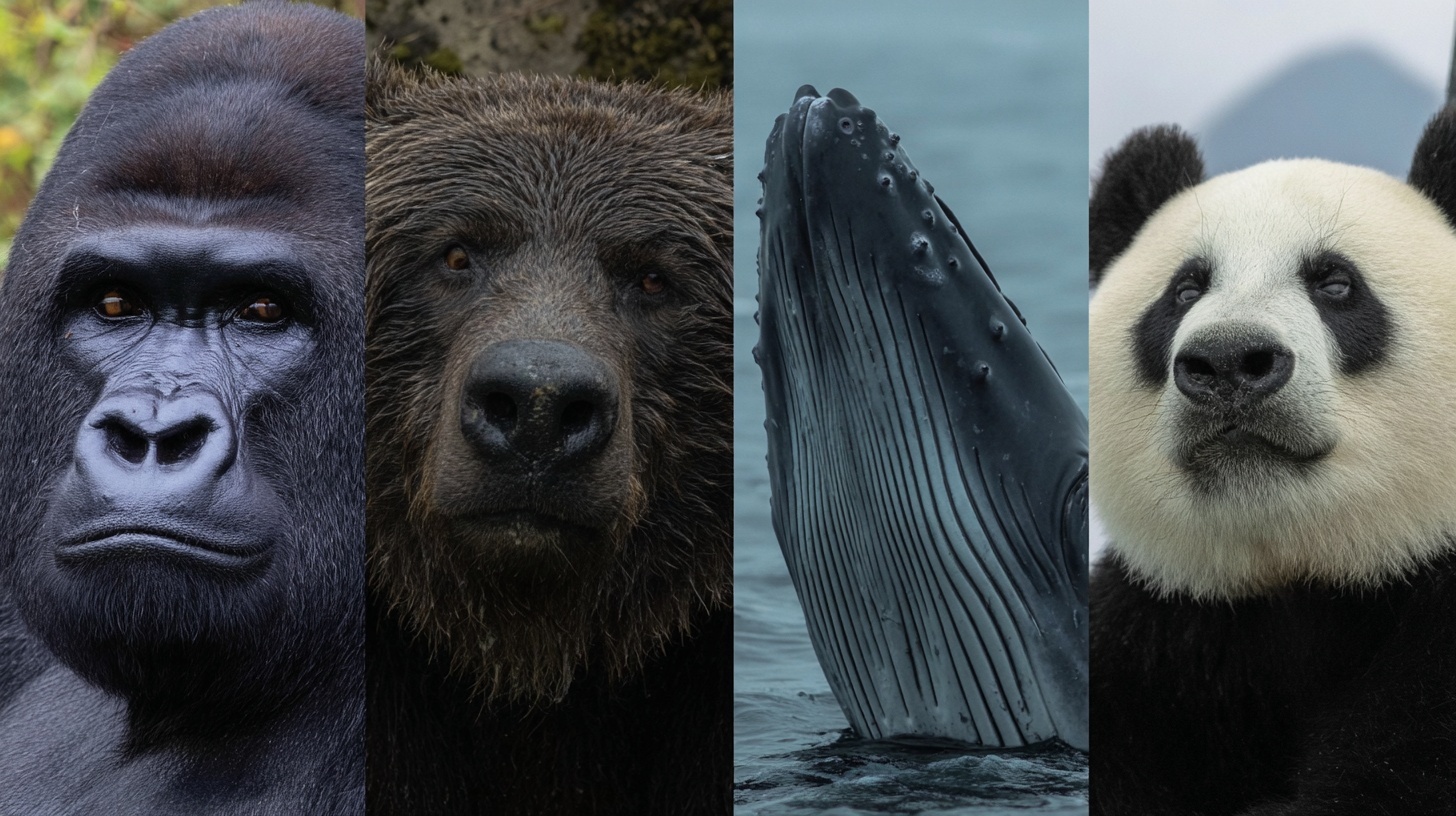
On a cool Tasmanian afternoon, a retired soldier stands in thick scrub, listening for a sound that officially should not exist.
On another continent, trackers in Rwanda climb through volcanic mist counting newborn gorillas, while ranchers in Montana string electric fences and hope the bears stay on the far side of the wire.
How far are we willing to go to keep another species on the planet?

Why these stories matter now
Scientists estimate that close to a million species face some level of extinction risk in the coming decades. That number is large enough to feel abstract. The 60 Minutes compilation on animals that faced extinction turns it into human-scale encounters: one tiger that may or may not still exist, one bear in a snare, one tortoise being carried out of a forest like stolen gold.
These pieces span more than a decade of reporting. Some animals are already gone in the wild, existing only in preserved DNA. Others are clawing their way back because people decided they should.
1. Tasmanian tiger: chasing a striped ghost
The Tasmanian tiger looked like a slender dog with dark stripes across its back, weighed about 55 pounds, and roamed Tasmania for thousands of years. In the early twentieth century it was declared a nuisance to sheep farmers. The government paid bounties for carcasses. By the mid-1930s only one captive animal remained, pacing a concrete enclosure in Hobart’s Beaumaris Zoo. It died in 1936.
Half a century without a verified sighting led officials to declare the thylacine extinct in 1986. Yet in Tasmania, the tiger never really left. Its silhouette decorates license plates and coats of arms. Locals in small pubs still tell stories of striped shapes slipping across back roads. Enthusiasts invest in motion-sensing cameras, satellite-linked traps, and long nights in the bush. Long-time seeker Adrien “Richo” Richardson carefully records what he believes are tiger calls echoing from both sides of a forestry track.
In a Melbourne laboratory, developmental biologist Andrew Pask and his team are trying to reverse extinction by editing the genome of a tiny marsupial called the fat-tailed dunnart. Their goal is to modify its DNA until its cells resemble those of a thylacine, then grow a living animal. The project, supported by investors and by the American company Colossal Biosciences, borrows tools from gene-editing and stem-cell science. Critics like Australian mammalogist Chris Helgen see it as more symbolic than practical—the biological gap between a mouse-sized carnivore and a wolf-sized apex predator is enormous.
People drove this animal off the island once. De-extinction is partly an attempt to answer a nagging question: if we could undo that, would we?
2. Grizzlies in Montana: conservation with teeth
When the Lewis and Clark expedition first wrote about grizzlies, there may have been 100,000 of them spread from Canada to Mexico. Settlers and ranchers saw them as a direct threat to life and property. Over the next 150 years, hunting and government eradication campaigns pushed them to near collapse. By the 1960s, only a few hundred grizzlies survived in the lower 48 states.
The Endangered Species Act listing in 1975 turned the tide. Core populations in Yellowstone and Glacier National Parks became the foundation for a slow recovery. Biologists like Eric Wenham now capture bears in remote Montana valleys using snare traps baited with beaver meat. In a makeshift forest “field hospital,” they sedate, weigh, measure, and sometimes collar the bears before releasing them. The collars reveal a valley where bears walk at night through spaces that look purely human by day—including within a hundred feet of a biologist’s house.
Grizzly numbers have more than tripled since the 1970s. Their range has doubled. Human populations have grown too, adding houses, hobby farms, and vacation cabins at the edge of bear country. Farmers report bears flattening cornfields and raiding melon patches. Ranchers lose dozens of cattle a year. Nonprofits like People and Carnivores work with them to install high-voltage fencing and secure attractants.
Some bears still cross the line from wild animal to repeat offender. When they learn to associate human trash, chicken coops, or livestock with easy calories, they become dangerous. Federal bear-recovery coordinator Hillary Cooley has authorized the killing of roughly fifty such animals in a single year. She calls it a necessary but miserable part of keeping both bears and people alive.

3. Mountain gorillas: turning tourism into protection
On the steep slopes of Rwanda’s Virunga volcanoes, mountain gorillas once hovered near extinction. When Dian Fossey began her research there in the late 1960s, only about 254 animals remained. Poachers killed gorillas for trophies. Farmers pushed their fields higher up the mountainside, eating away the forest.
Rwanda and neighboring Uganda now share more than 1,000 mountain gorillas. Around 600 live in Rwanda, the rest in Uganda. This is the only great ape whose population is increasing.
Each morning at Volcanoes National Park headquarters, small groups of tourists gather, masked and briefed on how to behave around the animals. A one-hour trekking permit costs about $1,500. Gorilla tourism has become one of Rwanda’s top sources of foreign revenue. Ten percent of the income flows back into villages surrounding the park. Communities decide whether to spend it on new classrooms, health centers, water tanks, or livestock cooperatives.
A small army of trackers follows each gorilla family every day of the year. They know every individual, monitor injuries and illnesses, and remove snares set for antelope that could maim an ape by accident. The Fossey Fund maintains a research campus, bone collection, and a “poop lab” that uses fecal samples to track stress hormones and genetics. A new green campus, partly underwritten by Ellen DeGeneres, will add space for scientists, exhibits, and local students.
Mountain gorillas remain vulnerable. Their entire population fits within a few patches of volcano forest, and any disease outbreak or political upheaval could undo decades of progress.

4. Humpback whales: from harpoons to hydrophones
The humpback whale was once a textbook example of industrial overkill. Commercial whaling fleets pursued humpbacks across oceans, harpooning and processing them at sea until only a few thousand remained worldwide. International bans on commercial whaling changed the rules, but enforcement remained patchy.
The 60 Minutes piece follows this story on two fronts. On the Southern Ocean, conservation group Sea Shepherd, led for many years by Paul Watson, confronts Japanese whaling vessels operating under a “research” loophole. Their ships throw lines to foul propellers and launch small boats to block the transfer of dead whales to processing factories. The tactics are aggressive and controversial. Watson argues that inaction means tacit support for illegal killing.
In the tropical Pacific, marine biologist Nan Hauser works from a quieter angle. Based on Rarotonga in the Cook Islands, she has spent years studying humpbacks that migrate thousands of miles between Antarctic feeding grounds and breeding areas in warmer waters. Her team tags whales with satellite transmitters to map their routes and records their songs underwater. One male may hang upside down, motionless, while a twenty-minute song rolls out through the dark. He repeats the pattern for hours, then innovates a new theme the following year.
Thanks to whaling bans, shifting public opinion, and science-driven advocacy, humpbacks have rebounded to an estimated 80,000 animals—about 30 percent of their pre-whaling numbers. Their biggest threats now are ship strikes and entanglement in fishing lines. Hauser hopes detailed migration maps will give regulators enough information to steer vessels away from the busiest whale corridors.
5. Turtles and tortoises: the slowest emergency
Turtles and tortoises have survived since before the dinosaurs, yet nearly half of the more than 300 species are headed toward extinction. Habitat loss, climate change, and a surge in illegal trade for meat, medicine, and status symbols are all part of the problem.
The program profiles Eric Goode, a New York hotel and restaurant owner who now spends much of his time and money trying to save the world’s rarest tortoises. His work takes him to Madagascar, where slash-and-burn agriculture has stripped away about 90 percent of the island’s forests and left rivers running red with eroded soil. Those remaining forests hold five species of rare turtles and tortoises, including the plowshare tortoise—a golden-shelled animal considered the most endangered tortoise on Earth.
Plowshares sell for tens of thousands of dollars in East Asian markets. Poachers slip into protected areas at night, following the same trails conservation patrols use by day. At one breeding center run with the Durrell Wildlife Conservation Trust, thieves broke past fences and guards to steal 75 young tortoises and two adults. Half the carefully raised breeding population, gone in a night.
Goode’s team began an extreme experiment in response. Using handheld drills, they cut shallow scars into the shells of wild plowshares, marring the smooth golden surface collectors prize. The tortoises are not harmed medically, but their commercial value drops. The work is hard to watch. It feels like vandalizing an art piece to save it from being stolen. No one knows yet if it will be enough.
Back in the United States, Goode has built a “tortoise hotel” in the hills outside Los Angeles. The facility houses hundreds of turtles and tortoises from three dozen endangered species, many confiscated from smugglers. Each enclosure replicates a distant habitat, from Burmese forests to Indian riverbanks.

6. Bonobos: a gentler cousin under siege
Bonobos look enough like chimpanzees that early researchers confused the two. Genetic tests show they are just as closely related to humans as chimps are, but their social lives follow a different script. Groups are led by coalitions of females. Conflicts tend to be defused with sexual contact rather than escalated with violence. Researchers see tool use, problem solving, and intricate vocal exchanges. They do not see deliberate killing of one another—something that appears regularly among chimps and humans.
Bonobos live only in the forests of the Democratic Republic of Congo, a country where decades of war and poverty have pushed wildlife down the priority list. In city bush-meat markets, monkeys and other forest animals are still sold as food. Bonobos are officially protected, yet orphaned infants continue to appear in the capital.
At the Lola ya Bonobo sanctuary near Kinshasa, founder Claudine André and her staff take in these traumatized youngsters. Each baby is paired with a human caregiver who acts as a surrogate mother—constant contact, bottle feeding, comfort. As they grow, the orphans move into groups where they learn bonobo behavior from one another instead of humans. By about age five they graduate into larger forested enclosures.
The sanctuary has taken the next step by releasing groups into a remote forest reserve along the Lomako or Lopori River. Getting there requires a three-hour flight into northern Congo and a day’s travel by dugout canoe. When André visits by boat and calls their names, the released bonobos gather along the riverbank, listening for the voice that once meant safety.
If the releases continue to succeed, they may create the first new wild bonobo population in living memory.
7. Giant pandas: when a national symbol becomes a shield
The giant panda is China’s national symbol and a global shorthand for endangered species. In the 1980s only about 1,200 remained in China’s bamboo forests. Habitat had been carved up by logging, farming, and roads.
The Chengdu Research Base of Giant Panda Breeding began as a shelter for injured pandas, run on a tiny budget with a handful of seriously ill animals. Over thirty years, scientists at Chengdu and partner institutions like the Smithsonian National Zoo have cracked some of the biological puzzles that made panda recovery so difficult.
Pandas eat almost nothing but bamboo, which is low in nutrition. Adults may spend sixteen hours a day chewing through forty pounds of stalks and leaves. Females can become pregnant only during a three-day fertility window once a year. Newborn cubs weigh about four ounces—the size of a stick of butter. In the wild, a mother that gives birth to twins usually raises only one.
Captive breeding programs learned to swap twins in and out of the den so each gets time with the mother and supplemental feeding from keepers. Veterinarians train adult pandas to voluntarily offer an arm through a slot in the enclosure wall for blood draws, avoiding repeated anesthesia. Better nutrition, careful genetic management, and this kind of cooperative care have lifted the captive population at Chengdu to about 200 pandas. Worldwide, wild numbers have climbed to just under 2,000—enough for the IUCN to downgrade the species from endangered to vulnerable in 2016.
China is now planning a massive panda national park of about 10,000 square miles that will connect fragmented habitats across three mountainous provinces. Conservation biologists call pandas an “umbrella species.” The corridors and forests protected for them will shelter lesser-known plants and animals sharing the same slopes.

What holds
None of these animals came back on goodwill alone. Grizzlies needed the Endangered Species Act, federal funding, and someone willing to tranquilize a 300-pound predator in the name of data. Mountain gorillas needed a government ready to tie protection directly to national revenue. Pandas benefited from being an icon that leaders refused to lose.
What doesn’t
These are not finished victories. Grizzlies can lose protection if political winds shift. Poachers can wipe out decades of plowshare breeding in a single night. Bonobos can vanish if the forests are logged or armed groups return. A disease outbreak could sweep through gorilla families or panda valleys. Climate change complicates all of it.
These animals are not safe. They are less unsafe than they used to be.
People once considered killing whales and shooting grizzlies standard practice. They stopped. That took money, patience, compromise, and years of work that rarely made headlines. Whether the work continues is still an open question.
Leave a comment