Updated October 19, 2026
Originally published January 26, 2023.
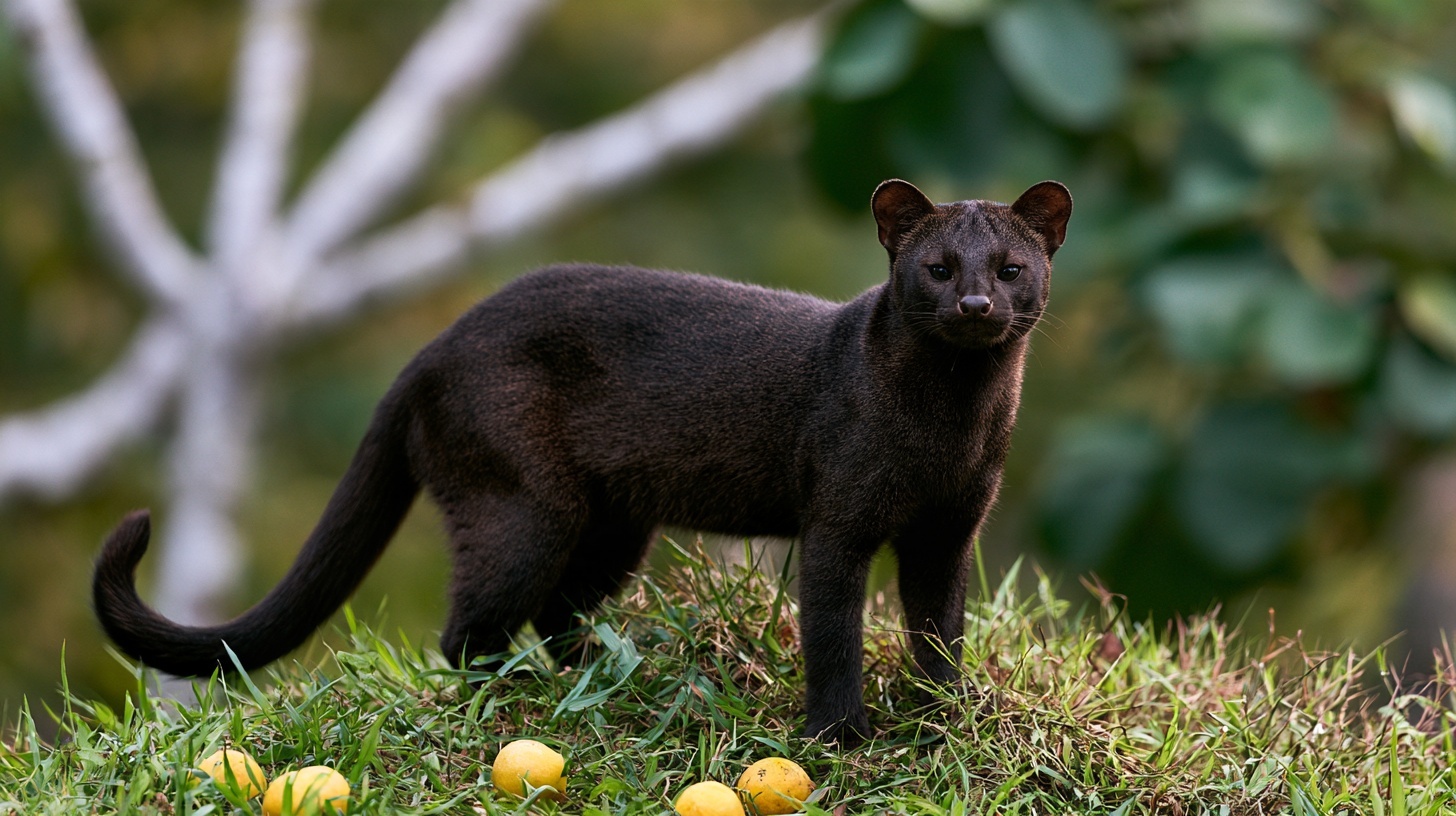
The jaguarundi carries its long body close to the ground, with a small head at one end and a remarkably long tail at the other. Its rounded ears barely interrupt the outline. That shape has earned this American wild cat a fitting nickname: otter cat.
Its short legs give it a very different build from the long-legged serval of Africa. Its family connections and daily habits offer surprises of their own, and researchers are still working out how many survive across its enormous range.
In 2026, the IUCN Red List moved the jaguarundi from Least Concern to Near Threatened. Its assessors identified a suspected population decline as agriculture, fires and other pressures alter the places where it lives.
The IUCN Cat Specialist Group gives a head-and-body length of roughly 19 to 31 inches, with another 11 to 23 inches of tail. Its reported weight range is about 5.5 to 17 pounds. A long animal can still be a relatively light one, especially when so much of its length belongs to the tail.
The coat is short and usually lacks the bold spots or rosettes familiar from many American wild cats. Some jaguarundis are gray or dark brown; others are reddish or chestnut. These color forms once led people to classify them as separate species. A mother can have reddish kittens alongside gray littermates.
The reddish jaguarundi pictured here was photographed at France’s Parc des Félins. Its rusty coat differs from the gray form, while its long torso, small ears and low stance retain the species’ distinctive outline.

Its relatives include two cats with very different builds: the puma and the cheetah. All three belong to the puma evolutionary lineage. The jaguarundi’s accepted scientific name is Herpailurus yagouaroundi, although older research often calls it Puma yagouaroundi. That older name appears in important studies and U.S. conservation documents.
Jaguarundis can climb trees and swim, and much of their hunting takes place on the ground. Their short legs carry them through vegetation in pursuit of small prey. The otter-like outline belongs to a predator at home among thickets and forest undergrowth.
Jaguarundis are generally solitary, except during mating or when a female is raising young. Observers have also seen pairs traveling or foraging together; some may be mothers accompanied by offspring that haven’t dispersed.
Much of what researchers know about breeding comes from captivity. Recorded pregnancies have lasted 72 to 75 days, and reported litters contain one to four kittens. Detailed accounts of reproduction in the wild remain scarce.
Daylight activity is one of their most distinctive habits. While many neighboring felines become active around dusk or after dark, jaguarundis are primarily active during the day. They can be difficult to see even then, especially where thick vegetation conceals an animal moving close to the ground.
Camera traps make it possible to compare those schedules without following each cat. A study published in 2023 examined records collected between 2009 and 2019 across eight landscapes in Guerrero, Mexico. Jaguarundis showed a daytime activity pattern, while ocelots and margays were nocturnal.
The cats used some of the same places despite keeping different hours. The researchers interpreted that separation in activity as one way these predators could coexist. For a jaguarundi, a landscape shared with other cats can offer a different set of encounters in daylight.
Food studies bring that daily life into sharper focus. Jaguarundis eat small mammals, birds, reptiles and invertebrates. Rodents are an important part of the menu, with other prey varying according to what is available in a particular landscape.
In southeastern Brazil, researchers studied jaguarundi feeding in a landscape of Atlantic Forest and eucalyptus plantations. During fieldwork in 2000 and 2001, they walked about 354 miles in search of small-cat scats and regurgitated material. Their findings appeared in a 2009 paper.
First they had to establish which cat had left each sample. Jaguarundis swallow some of their own hair while grooming, and those hairs can end up in their droppings. The team compared hair structure under a microscope with reference material to identify the predator.
That work yielded 24 jaguarundi scats and two regurgitated samples. Teeth, feathers, scales and other remains helped reveal 19 kinds of food. Small rodents featured prominently, and the researchers also identified pit-viper remains. Even a small collection contained evidence of meals ranging from mammals to venomous snakes.
Elsewhere, fish have occasionally been recorded as prey, including fish stranded in puddles. The broader picture is of a flexible hunter of small animals, able to take advantage of different food sources across its range.
Jaguarundis inhabit environments ranging from scrub and savanna to forests and wetlands. Their distribution extends from Mexico through Central America and well into South America, reaching central Argentina. This is a cat with a wide geographic reach, able to use landscapes that look very different from one another.
Even so, cover remains important. Brush, streamside vegetation and connected patches of habitat can let an animal move between feeding areas without crossing a completely exposed landscape. A patch of greenery beside farmland may therefore serve a purpose that isn’t obvious from its size.

A wide range doesn’t mean a secure future
For researchers, one of the hardest questions is how often those habitats actually hold jaguarundis. A range map shows where a species occurs, but it can’t tell us how densely animals occupy every part of that territory. The jaguarundi’s plain coat creates another practical difficulty: individual cats usually lack conspicuous markings that would make them easy to tell apart in camera-trap images.
A study published in April 2024 gathered records from 182 camera-trap surveys in 13 countries. The data covered work carried out between 2003 and 2021, bringing together scattered detections that could otherwise have remained buried in separate projects.
The combined dataset contained 884 jaguarundi detections. Some animals could have appeared more than once, so that figure represents photographic records rather than a count of distinct cats. The researchers used a model that allowed for animals being present even when a camera failed to photograph them.
The model predicted a low likelihood of jaguarundis using much of the Amazonian lowlands, an enormous area within the species’ mapped range. The surveys left a gap in Amazon coverage, so that prediction particularly needs to be tested in the field. The team’s camera records also documented jaguarundis beyond parts of the range map then in use, including Andean foothills.
The problem becomes particularly consequential at the northern edge of the jaguarundi’s historical range. Southern Texas once held the species. Its last confirmed U.S. record came in April 1986, when a road-killed animal was found near Brownsville.
Reports of possible sightings continued, but a long-running research effort produced a different kind of evidence. A 2022 paper analyzed surveys conducted between 2003 and 2021. Across 685 camera sites in Texas, representing 350,366 trap nights, researchers recorded no jaguarundis.
The work covered 16 properties and two highways in southern Texas. Cameras watched wildlife trails, ranch roads and areas with woody cover. Every Texas survey location produced bobcat photographs. Two ranches also yielded ocelot records. The equipment was finding wild cats, including species that shared parts of the jaguarundi’s historical habitat.
Their surveys in northeastern Mexico did photograph jaguarundis. On two properties in Tamaulipas, the team obtained 126 detections. That comparison helped support their conclusion that jaguarundis were probably extirpated, or locally extinct, in the United States. The field-camera photograph below comes from the Mexican part of that research.
The U.S. Fish and Wildlife Service’s August 2024 review likewise reported no confirmed U.S. records since 1986. It recommended retaining federal Endangered status for the Gulf Coast jaguarundi, whose remaining distribution is in Mexico. The IUCN assesses the species across its entire range.

The 2022 researchers recommended a recovery effort that could include reintroduction. Their proposed work included finding suitable habitat in Texas and assessing Mexican populations that might supply animals. Those are linked questions: a release needs somewhere cats can survive, and any source population needs to be understood before animals are removed.
Habitat loss, roads and barriers to movement all feature in the federal review. It describes border infrastructure as an additional obstacle to connections between suitable areas in the United States and Mexico. Maintaining safe routes across roads is part of the wider challenge of keeping wildlife habitat connected.
Across Latin America, the 2026 global Red List assessment raises related concerns on a larger scale. The assessors suspect a population decline exceeding 20 percent over three generations, a period spanning past and future change. The assessment was completed in August 2024 and published in 2026.
They identify agricultural expansion, habitat fragmentation, fires and road deaths among the pressures. Clearing vegetation can remove hunting cover and divide surviving habitat. Jaguarundis also encounter disease associated with domestic animals and face retaliatory killing when they take poultry.
Vaccination campaigns for domestic animals, also described in the assessment, aim to reduce the risk of infections reaching wildlife. Protecting scrub and forest patches, and maintaining routes between them, addresses the cats’ need for cover and prey.
Other work starts at a chicken coop. Conservation groups are helping farmers protect poultry in Brazil, Mexico and Costa Rica. Building or repairing henhouses makes birds harder for predators to reach. Protecting a family’s chickens can also remove one reason for someone to kill the small wild cat nearby.


Leave a comment