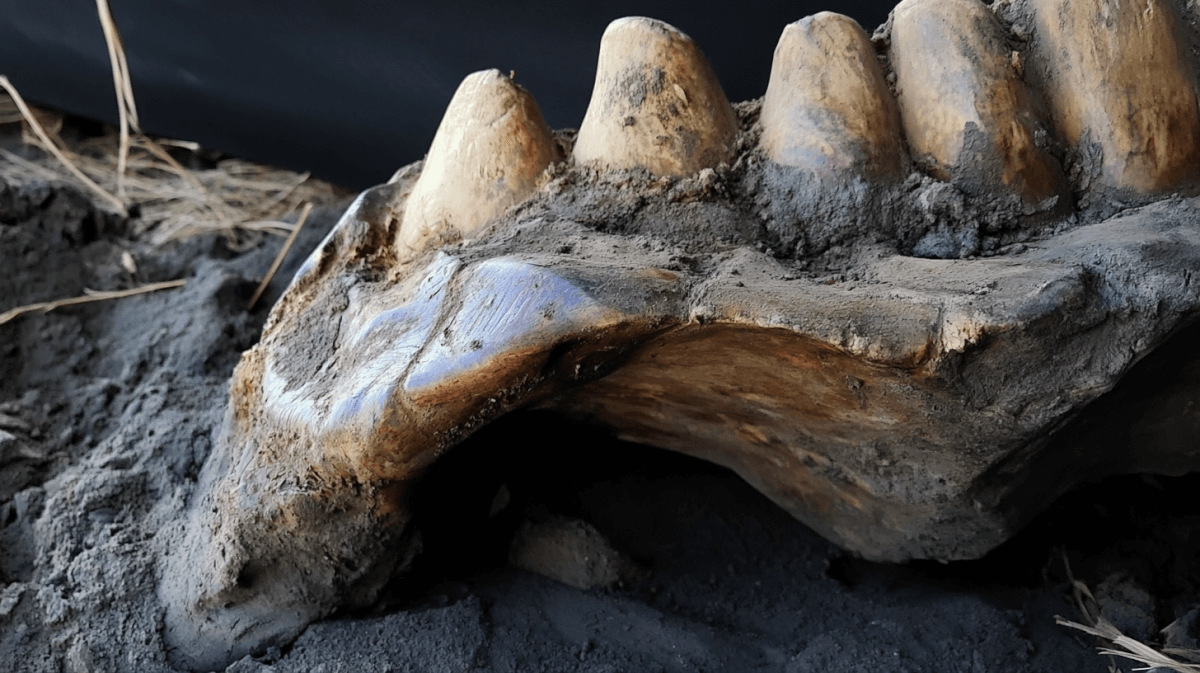
A homeowner in Orange County, New York, was mowing the lawn one afternoon when something caught his eye beneath a thin layer of dirt. Hef thought it was a baseball at first.
As he drew closer, he realized he was holding a massive tooth, heavy and ridged, unlike anything he had seen before. Unsure what to make of it, he reached out to local experts. They soon confirmed that it wasn’t just a curious rock. It was part of a mastodon jaw, an Ice Age relic from thousands of years ago.

Echoes of the Ice Age
Word spread quickly among museum professionals and faculty at SUNY Orange. Dr. Cory Harris, an archaeologist who chairs the Behavioral Sciences Department, recalls his excitement: “Orange County has a lot of mastodons relative to the rest of the state and, really, the rest of the country, but that still doesn’t mean you find it every day.”
Once a team arrived at the property, they uncovered more than just a tooth. Buried nearby were additional pieces of what turned out to be a nearly complete jaw, along with fragments of a rib and a toe bone.
This find is significant because a well-preserved mastodon jaw has not surfaced in New York for over a decade. Researchers say the details of these fossils, including wear patterns on the teeth and the condition of the bone, can reveal clues about the mastodon’s diet, environment, and possible interactions with humans.
Scientific and Community Impact
The New York State Museum is now studying these remains. Dr. Robert Feranec, Director of Research and Collections, describes the importance of such discoveries: “Fossils are a non-renewable resource. Each specimen is really an important thing, and I can get a lot of information out of it.”
Through techniques like carbon dating and chemical analysis, scientists hope to determine the mastodon’s exact age, as well as the climate and vegetation that shaped its habitat.

Although New York has yielded over 150 mastodon fossils, roughly a third have come from Orange County. Experts trace this abundance to ancient glaciers that created ideal conditions for preserving bones in wetlands and glacial lake beds. Yet even in a fossil-rich area, the property owner never expected to stumble onto a piece of prehistory. “I’m thrilled that our property has yielded such an important find for the scientific community,” he said in a brief statement.
The mastodon’s remains are slated for further study and eventual display. The homeowner, who prefers to keep a low profile, granted the museum permission to excavate deeper into the yard hoping to find more. Dr. Harris notes that while the jaw garners most of the attention, smaller bones can offer valuable context. He also points out that such discoveries remind us how much of Earth’s story might still be hidden under everyday lawns.
Looking Ahead

Scientists believe mastodons once roamed the region in search of lush forests. They stood about ten feet tall and had stout tusks suited for pushing through thick vegetation. When the last Ice Age ended, shifting climates and human presence likely contributed to their demise. This jaw, and the other bones found nearby, may help piece together a timeline of events that shaped the landscape and the creatures that once called it home.
The homeowner’s initial shock at finding a tooth the size of a baseball has grown into a deeper appreciation for the passage of time. In a single afternoon, a routine chore became a link to an ancient world. “Initially I just thought we would poke around and pull the tooth out of the ground,” Dr. Feranec recalled to ABC Eyewitness News. “But as we poked around that other tooth, it wasn’t moving.” That moment, and the discovery that followed, underscores how history can appear when and where you least expect it.


Leave a comment