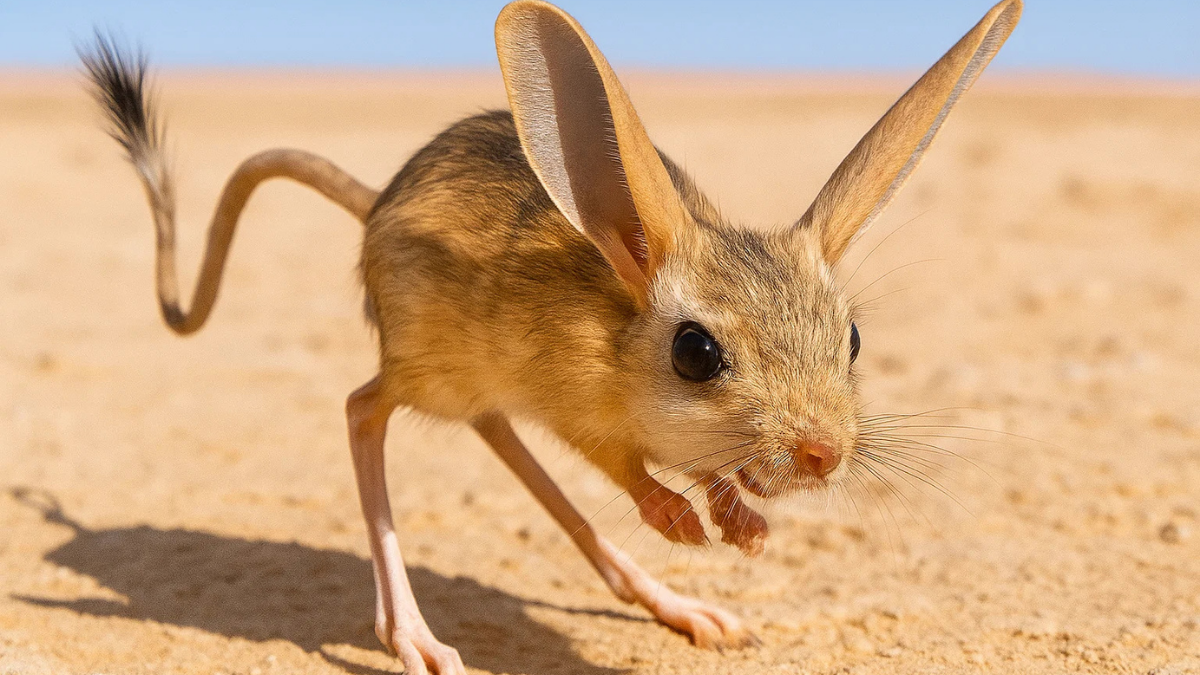
Small enough to fit in the palm of your hand yet capable of leaping more than six feet in a bound, the jerboa is one of the desert’s most unlikely survivors. Its long legs, tufted tail, and oversized ears make it look like a creature from a fairy tale, but each trait has been honed by millions of years of evolution to thrive in the world’s harshest landscapes.
By day, jerboas vanish underground. Their burrows, sometimes several feet deep, shield them from searing heat and predators. At night, they emerge under starlit skies to forage for seeds, shoots, and insects. Their pale fur blends seamlessly with sand, while stiff hairs on their feet act like built-in snowshoes, keeping them from sinking into loose dunes.

Their bodies are laboratories of desert adaptation. Long ears act as natural radiators, shedding excess heat when days scorch and nights freeze. Sharp hearing lets them detect the faintest wingbeat of an owl or the soft crawl of a snake. Most remarkably, jerboas may go their entire lives without drinking water. They extract every drop of moisture they need from their food, conserving it with kidneys so efficient they produce almost no waste.
When danger strikes, the jerboa’s escape is as dramatic as it is effective. It launches into a zigzagging sprint, hopping unpredictably at speeds near sixteen miles per hour. Each leap is powered by hind legs proportionally longer than a kangaroo’s, with the tail working as a counterbalance and steering rudder midair. This erratic movement confuses predators and turns a small rodent into a spring-loaded puzzle too tricky for even owls and foxes to solve.
Desert survival strategies
Yet jerboas are not only prey. They play an important role in their ecosystems: dispersing seeds, aerating soil with their burrows, and keeping insect populations in check. Their presence supports the balance of desert life, from plants to predators. Their story is also one of convergent evolution. On three continents, different animals—North America’s kangaroo rats, Australia’s hopping mice, and Africa’s springhares—have evolved similar traits, proving that hopping on two legs is one of nature’s best answers to survival in open, arid landscapes.
Modern science has even turned to the jerboa for inspiration. Engineers studying their unpredictable leaps are applying those lessons to agile robots built to cross shifting sands or disaster zones. Fiction, too, has borrowed from them. Frank Herbert’s Dune describes the desert mouse “Muad’Dib,” a creature that hides from the sun and creates its own water—an uncanny echo of the jerboa’s real abilities.

Despite their resilience, some jerboas face threats. Mining, overgrazing, and agriculture reduce their habitats. In parts of Asia, the long-eared jerboa is listed as endangered, with feral cats adding new pressure. Climate change, with its harsher droughts and shifting habitats, presents another challenge. Conservation programs, like the EDGE of Existence initiative, now spotlight jerboas as evolutionarily unique species worth protecting.
The jerboa’s tale is one of ingenuity and grace. In landscapes where survival seems impossible, this tiny desert acrobat reminds us that adaptation can be both practical and wondrous.


Leave a comment