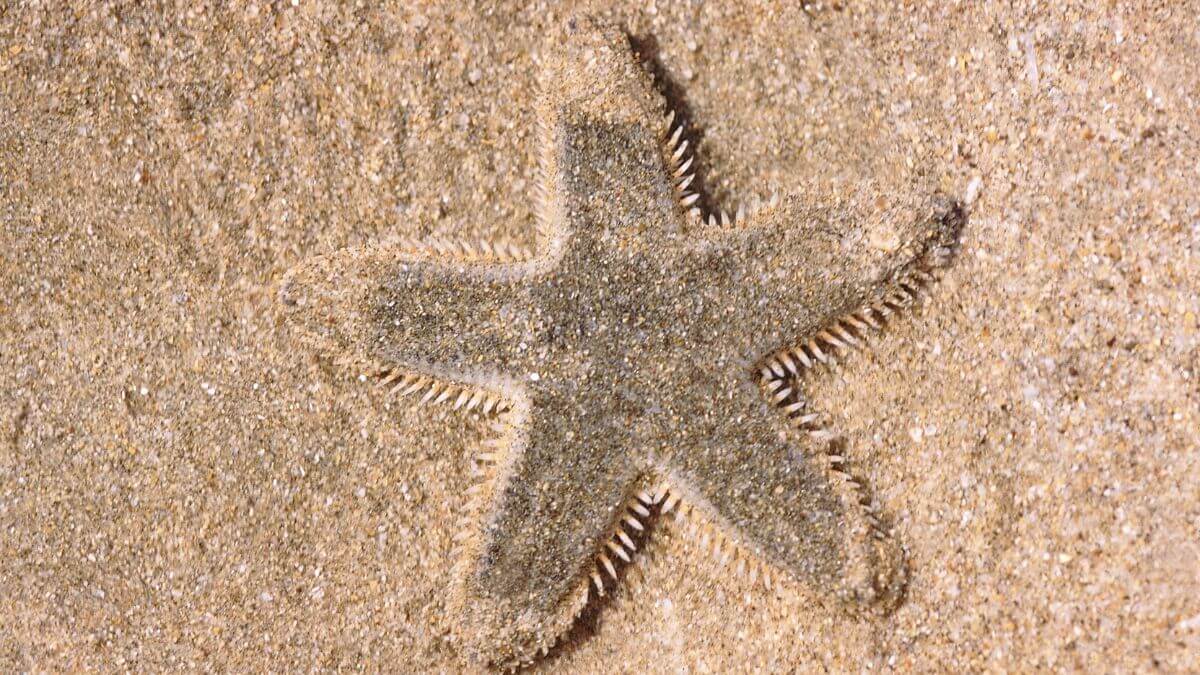
Starfish, fascinating creatures that inhabit our oceans, are known for their unique appearance and intriguing biology.
One aspect of their anatomy that plays a crucial role in their daily life and often intrigues researchers and enthusiasts alike is their tube feet.
These small, tubular projections are situated on the oral face of the starfish and are responsible for various functions, including movement.
The way starfish utilize their tube feet for movement is a remarkable process. Water is pumped into the tube feet, extending slim tubes that form part of their water vascular system.
This system allows starfish to control their numerous tube feet and move in any direction, with any of their arms taking the lead.
Though their movement may be slow, it is incredibly well-adapted to their underwater environment, providing stability and efficiency in navigating their surroundings.
Starfish Anatomy and the Water Vascular System
Morphology of Tube Feet
In sea stars or starfish, which belong to the class Asteroidea, one of the most fascinating aspects of their anatomy is their tube feet.
These small, flexible, and elongated structures extend from the underside of each of the starfish’s arms.
Each tube foot, also known as a podium, ends in a rounded tip equipped with a suction cup. These tube feet are arranged in rows along the length of the starfish’s arms.
The Role of the Water Vascular System
The water vascular system is an essential part of how sea stars function, particularly in the movement and function of their tube feet. This hydraulic system operates using seawater instead of blood.
It begins at the madreporite, a sieve-like structure on the upper surface of the starfish’s body.
Seawater enters through the madreporite and then into a small sac called the ampulla, which is connected to a calcareous-lined duct called the stone canal.
Water moves into the ring canal from the stone canal, which encircles the starfish’s central disc.
Radial canals run along the length of the arms, with lateral canals branching off and connecting to the individual tube feet.
When the ampulla contracts, hydraulic pressure forces water into the podium, causing it to extend. The suction cups at the end of these tube feet then attach to the substrate, allowing the starfish to move or maintain its position.
Aside from locomotion, the tube feet also play a crucial role in feeding. Some starfish species, such as the Crown-of-thorns starfish, use their tube feet to manipulate and hold onto their prey, which is often coral polyps.
In addition, the coordination between tube feet and the water vascular system enables starfish to open bivalves such as clams or mussels.
As echinoderms, sea stars have a remarkable ability to regenerate lost arms or damaged tube feet. This characteristic further highlights the importance of their anatomy and the water vascular system in their survival and success in a wide range of marine environments from the Arctic to the tropical Indo-Pacific regions.
Functions and Behaviors of Tube Feet
Locomotion Across Marine Substrates
Tube feet are essential for starfish to move across various marine substrates such as sand, mud, and rocky surfaces.
Starfish can easily grip and walk along these surfaces by skillfully controlling their tube feet in a wavelike motion.
Some species, like the northern sea star, can even travel up to a mile in one week. These remarkable locomotion capabilities also allow starfish to cling to rocks and other hard surfaces to withstand strong currents.
Tube Feet in Feeding and Prey Capture
In addition to their role in locomotion, tube feet also aid starfish in feeding and capturing prey. Starfish are predatory echinoderms, often feeding on bivalves such as clams and mussels.
Employing their tube feet, they can grasp and manipulate these prey items, even prying open the shells of bivalves with their powerful muscles.
Once a starfish captures its prey, it can extend its stomach out of its body and into the prey’s shell to begin digestion. This unique strategy helps them successfully obtain nutrients from their environment.

Sensory and Regenerative Capabilities
One of the lesser-known functions of tube feet is their role as sensory organs.
These tube feet contain sensory cells and enable the starfish to detect touch, taste, and even smell in the water surrounding them. This allows them to navigate their environment and locate prey more effectively.
Additionally, tube feet serve an essential role in the remarkable regenerative capabilities of starfish. Many species of sea stars, part of the phylum Echinodermata, have the ability to regenerate lost or damaged arms and even their entire body under certain circumstances.
The tube feet are vital in helping the starfish re-grow new arms and re-establish its water vascular system, which is crucial for overall survival and functioning.
Starfish tube feet play an essential role in various aspects of their life, from locomotion and feeding to sensory perception and regeneration.
These versatile structures are a testament to the adaptability and resilience of marine invertebrates, especially those belonging to the Echinodermata phylum.
Leave a comment