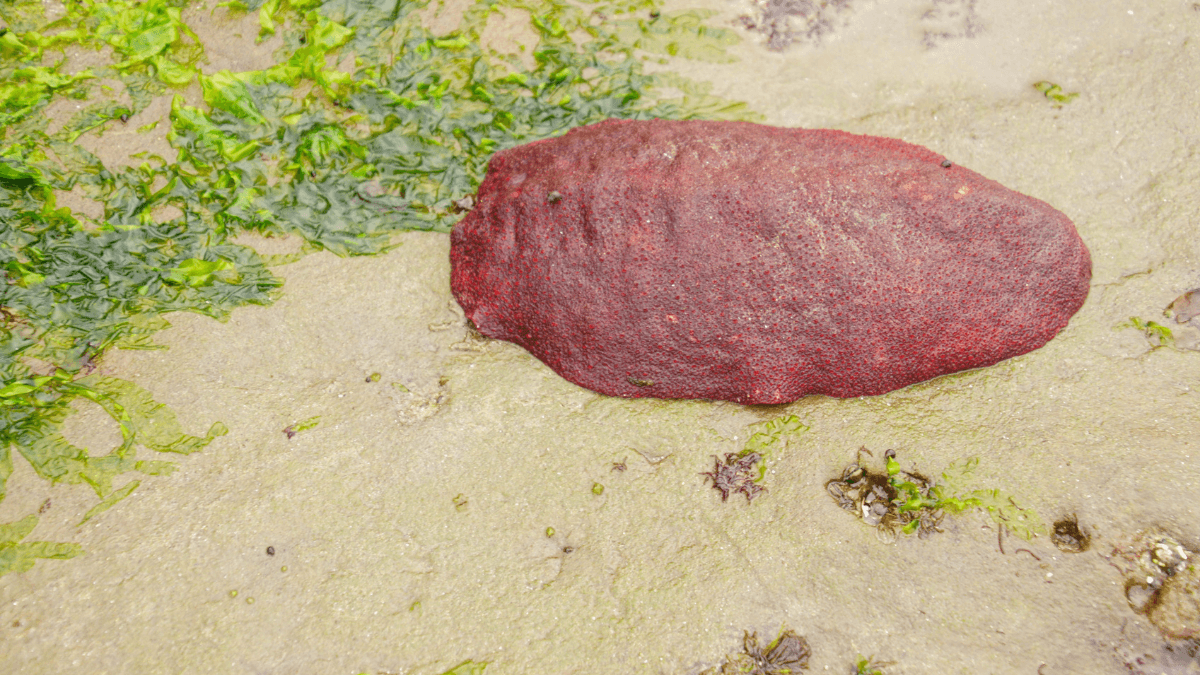
The gumboot chiton, known scientifically as Cryptochiton stelleri, is a remarkable marine mollusk native to the coastal waters of the Pacific Ocean.
This species, often referred to as the giant Pacific chiton, is the largest chiton species worldwide. It thrives along the North American Pacific coast, from the temperate shores of Central California to Alaska.
Its range reaches the Aleutian Islands to the Kamchatka Peninsula and south to Japan. The distinctiveness of the gumboot chiton lies not just in its size but also in its unique adaptation of having a leathery girdle that covers its shell plates.
Distinct from other chitons, the gumboot chiton features a fleshy, reddish-brown mantle that entirely encases its eight articulating shell plates. This tough outer covering protects the chiton from both physical damage and from becoming a substrate for other marine organisms.
This large chiton is a coastal dweller commonly found attached to rocks in the intertidal zones, where it scrapes off algae for sustenance. Their powerful radula, an anatomical structure used for feeding, contains magnetite. This gives it the hardness and durability to erode rocks during feeding.
Despite their size and sturdy build, marine researchers find Cryptochiton stelleri elusive. This is partly due to their habitat in the often turbulent and inaccessible regions of the Pacific coast. They play an integral role in their native ecosystems, contributing to the oceanic food chain and showcasing the biological diversity of the Pacific’s tidal zones. Their lifecycle and behavior echo the complex interplay of adaptation and survival in a dynamic marine ecosystem.
Gumboot Chiton’s Anatomy and Physiology
The gumboot chiton (Cryptochiton stelleri) is a distinctive marine invertebrate within the class Polyplacophora, a part of the phylum Mollusca. It possesses a series of eight dorsal shell plates, which are often obscured by a leathery girdle, a tissue that extends over the shells. These plates are composed of aragonite, a carbonate mineral.
The gumboot chiton is notable for its use of magnetite. This biomineral is found in its radula, a specialized feeding tool that resembles a tongue studded with teeth. It allows the chiton to scrape algae from rock surfaces.
The gumboot chiton grows to a considerable size, reaching up to 36 cm, and can be found at depths of up to 65 feet.
Internally, its mantle secretes mucus and envelopes the internal organs. Meanwhile, the mantle cavity houses the gills responsible for gas exchange. The chiton can absorb oxygen directly from water and, to a lesser extent, from air if the gills remain moist.
The gumboot chiton’s heart consists of two auricles, a single ventricle, and an aorta, which pump circulatory fluids through its body. Sensory reception is facilitated by special structures called aesthetes, which can detect light and possibly other environmental stimuli through the chiton’s mantle.
An intriguing aspect of its anatomy is that certain species, such as the Tonicella lineata, display scales rich in magnetite, which suggests a role in navigation via the Earth’s magnetic field.
Gumboot Chiton’s Habitat, Diet, and Behavior
Habitat
The gumboot chiton resides primarily in the intertidal to subtidal zones along the northern Pacific Ocean.
These mollusks prefer rocky habitats. They are often found clinging to rocks near low tide levels and down to depths of approximately 20 meters. They are well-adapted to this environment, with their robust, flexible girdles allowing them to blend into the surrounding area.
Diet
Their primary diet consists of various species of algae, including sea lettuce, kelp, red algae, and other microorganisms like diatoms.
Gumboot chitons have a specialized radula, a tooth-like structure, which they use to scrape food off the surface of rocks.
Behavior and Reproduction
The reproductive behavior of gumboot chitons involves the release of eggs and sperm into the water, where external fertilization occurs.
Females release millions of eggs, which become trochophore larvae and are part of the planktonic community before settling down and developing into adults.
Predators
The gumboot chiton’s natural predators include sea stars, various snails, crabs, and mammals like sea otters and river otters.
Despite being well-camouflaged and tough, they can still fall prey to these predators that have adapted to feed on them.
Leave a comment