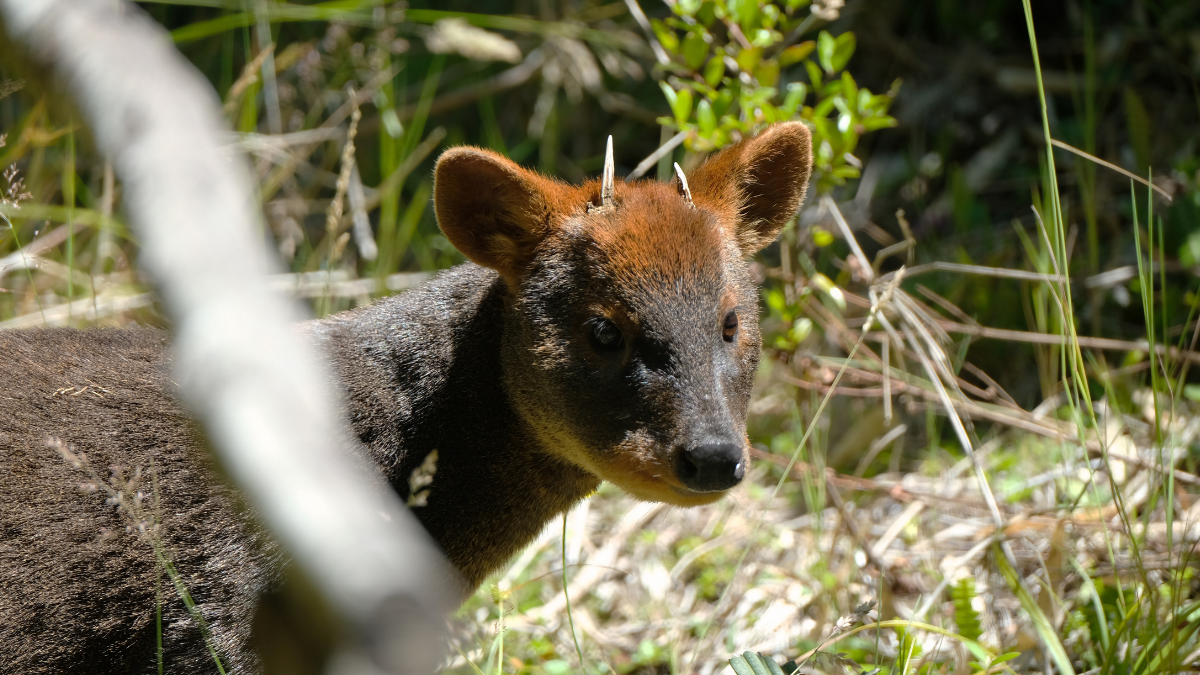
For years, the pudu has held a quirky claim to fame as the world’s smallest deer. Standing little more than a foot tall, it’s a shy forest dweller that dashes in zigzags when threatened. But scientists recently uncovered that this miniature deer isn’t just one species. It’s at least three, and one of them may be even tinier than the rest.

In 2024, a team led by Peruvian biologist Javier Barrio described a new species, Pudella carlae, living in the cloud forests of central Peru. The discovery shook up the deer family tree. What was once thought of as the northern pudu turned out to be two distinct animals separated by the Huancabamba Depression, a natural barrier in the Andes. The original northern pudu kept its name (Pudella mephistophiles) and range in Ecuador and Colombia. The new P. carlae lives farther south in Peru and is the first deer species described in the Americas in more than 60 years.
Researchers emphasized that the two populations occupy very different ecosystems, one in high-altitude páramo grasslands and the other in montane cloud forests. That ecological divide, combined with differences in skulls, coats, and DNA, was enough to classify the Peruvian population as a separate species and to revive the genus Pudella for the northern lineage. The better-known southern pudu (Pudu puda), found in Chile and Argentina, remains the sole member of the original genus Pudu.
The split has conservation consequences. Instead of a single widespread population, there are now two smaller, more vulnerable ones. P. carlae is confined to a narrow band of Peruvian cloud forest, where agriculture and wildfires nibble at its habitat. P. mephistophiles holds on in the high páramo, but remains poorly studied. Both species will need fresh evaluations of their risk status. Meanwhile, the southern pudu in Chile and Argentina continues to be threatened by deforestation and poaching.

The taxonomic update also settles a playful debate: which deer is truly the smallest? That crown belongs to Pudella mephistophiles. Adults weigh as little as 11 pounds and stand just over 12 inches at the shoulder, edging out both P. carlae and the southern pudu, which is slightly larger and can reach more than 20 pounds. In other words, the tiniest deer on Earth just got even more specific, and rarer.
How the tiniest deer escapes predators
If taxonomy revealed surprises about what pudus are, behavior shows how they survive. When chased, pudus don’t run in straight lines. Instead, they bound side to side in sudden zigzags, vanishing into the underbrush. The move may look comical, but it’s a highly effective survival tactic. A predator like a fox or puma can sprint faster, but can’t pivot nearly as sharply. One misstep, and the pudu disappears.
Biologists call this kind of erratic flight “protean behavior,” and it’s seen in animals as different as rabbits and gazelles. By breaking the rules of predictable motion, prey force predators into constant recalculation. For the pudu, living in forests dense with trunks and vines, zigzagging makes even more sense. It allows the deer to use its small size and low center of gravity to slip away into cover where a larger hunter loses momentum. The southern pudu, which is more often observed in Chilean forests and in captivity, has been repeatedly documented showing this same zigzagging escape. That confirms it as a hallmark behavior across the entire pudu lineage.

Despite its fame online as a wide-eyed woodland sprite, the pudu remains one of the least studied deer in the world. We now know there are three of them, each with its own ecological niche. And we know that when danger comes, the tiniest deer runs like no other, side to side, a flash of rust-brown vanishing into the forest shadows.

Leave a comment