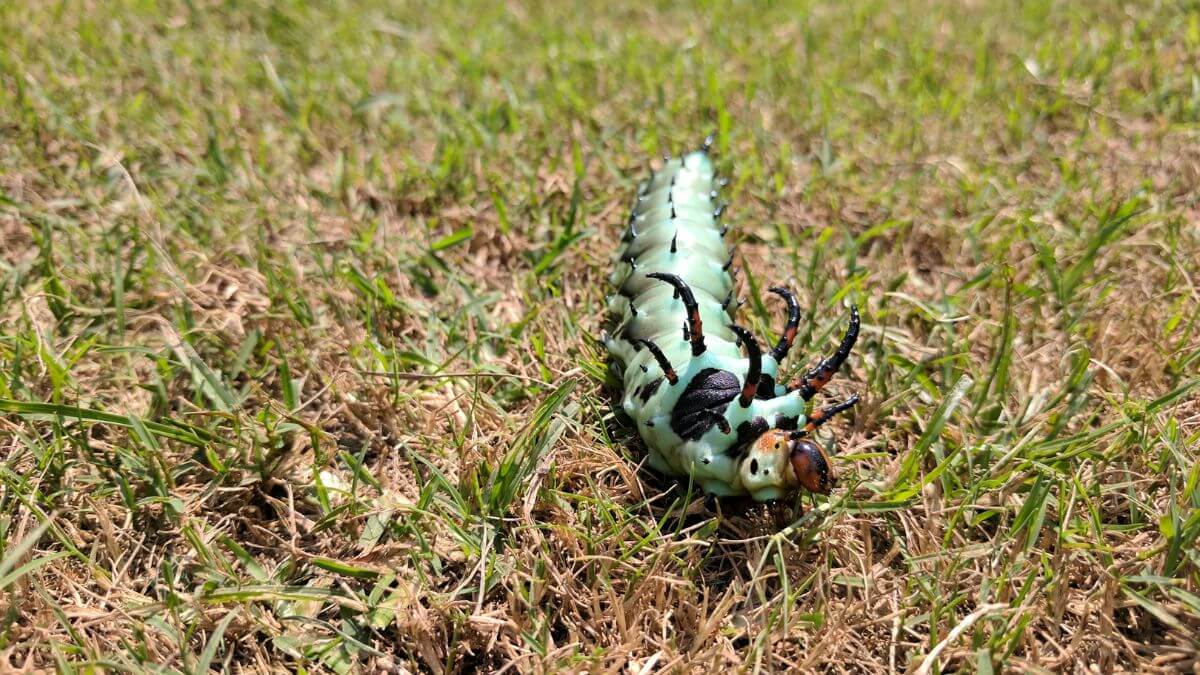
From the forest floor to the fluttering branches above, the world of insects is rife with enchanting creatures that surprise and inspire. Today, we delve into the intriguing life of one such creature, known for its striking and somewhat fearsome appearance: the Hickory Horned Devil.
But fear not, for despite its dramatic name and unusual aesthetics, this creature is a harmless and fascinating example of nature’s boundless creativity.

One of the largest caterpillars and moths in North America
The Hickory Horned Devil is the larvae of the Regal Moth (Citheronia regalis), one of the largest moths native to North America.
With a wingspan that can reach up to 6 inches, the Regal Moth is a striking sight. But it’s during its larval stage that this creature truly steals the spotlight. The Hickory Horned Devil can grow up to 5.5 inches long, making it one of the largest caterpillars in North America.
Decked out in vivid turquoise with a lineup of horn-like spines, the Hickory Horned Devil could easily be mistaken for a creature from a sci-fi tale. The large, orange-red horns on its thorax, which lend it its devilish name, are particularly noteworthy.

The Hickory Horned Devil’s Habitat and Diet
The Hickory Horned Devil is found primarily in the deciduous forests of the eastern and southern United States. As its name suggests, one of its primary food sources is the hickory tree, but it doesn’t stop there. These caterpillars also feed on the leaves of other hardwood trees, such as walnut, pecan, sweetgum, and persimmon.
Despite its intimidating appearance, the Hickory Horned Devil is not a threat. The caterpillar’s horns, though menacing, are entirely harmless and are a classic example of nature’s art of deception. This form of mimicry is a defensive strategy used to deter potential predators.

The Hickory Horned Devil’s breathtaking transformation
After gorging on leaves for about a month, the Hickory Horned Devil prepares for its next spectacular act – metamorphosis. It burrows into the ground, crafting a small chamber where it transforms into a pupa. Here, tucked away in the quiet underbelly of the forest, it undergoes a complete transformation, emerging the following year as a Regal Moth.
The adult moth is a stark contrast to its larval form. With soft, gray-brown wings patterned with spots of orange and pink, it’s a far cry from the vibrant, spiky caterpillar it once was. The adult moths live for about a week, just enough time to mate and lay eggs for the next generation of Hickory Horned Devils.
The life of a Hickory Horned Devil, from its startling larval stage to its stunning metamorphosis into a Regal Moth, represents the transformative magic of nature.
Like these horns? Be sure to check out the three-Horned Chameleon as well.
Leave a comment