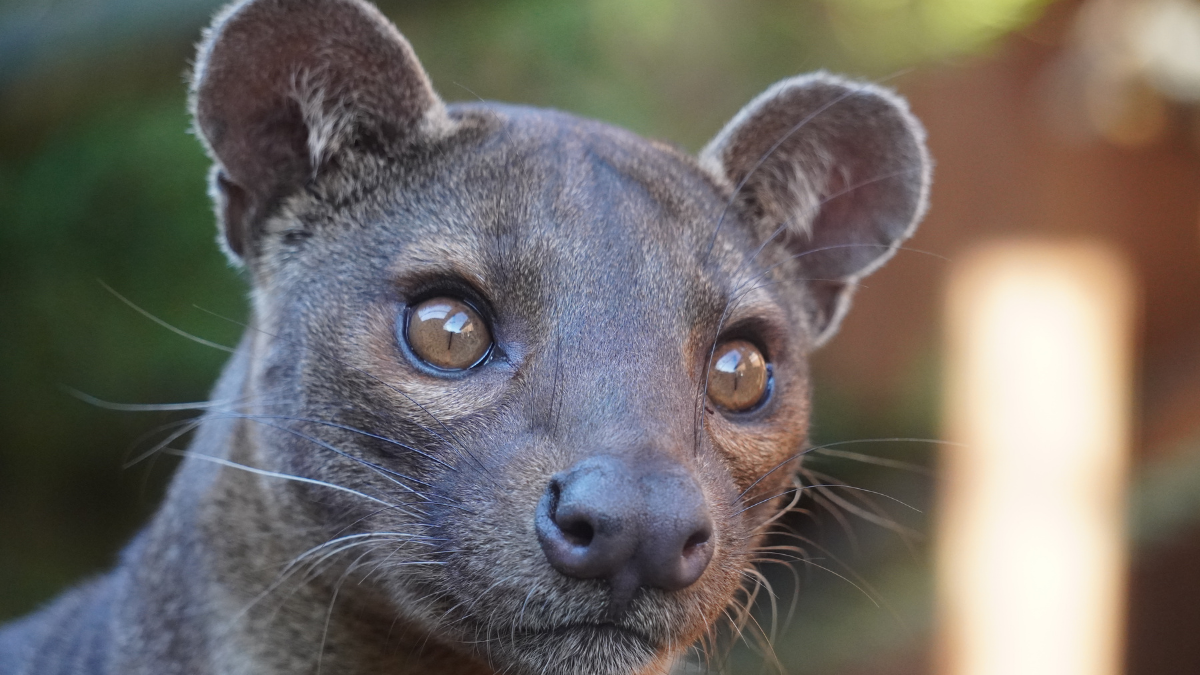
At first glance, the fossa of Madagascar could be mistaken for a sleek wild cat. It prowls through the forest on silent feet, balances with a long tail, and flashes eyes suited for night hunts. Yet despite this feline disguise, the fossa is not a cat at all. It belongs to a family of carnivores found nowhere else on Earth: the Eupleridae.
Millions of years ago, a mongoose-like ancestor drifted across the Mozambique Channel, likely clinging to vegetation swept from Africa. On Madagascar, isolated from lions, leopards, and other continental predators, its descendants radiated into new shapes. Today, the fossa is the largest of them, an apex hunter that looks uncannily like a cougar but is genetically closer to mongooses.

This is a classic case of convergent evolution. The fossa needed to fill the role of a forest cat, so natural selection shaped its body toward that niche. It evolved semi-retractable claws for gripping bark, flexible ankles to climb down trees headfirst, and a slender, muscular frame for ambushing prey. Its resemblance to a cat is not shared ancestry but adaptation to the same ecological demands.
The illusion fooled science for over a century. Early naturalists slotted the fossa with civets, while later anatomists argued it was a primitive cat. Only in the 1990s did genetic studies settle the debate: Madagascar’s carnivores, from mongoose-like vontsiras to the cat-like fossa, all stem from a single colonization event.
Madagascar’s hidden lineage
The fossa’s lifestyle reinforces the likeness. It stalks lemurs through the canopy and on the forest floor, hunting alone with the stealth of a leopard. Lemurs make up more than half of its diet, but it will take almost anything it can overpower. Occasionally, observers have even recorded groups of males working together to bring down large prey—behavior rare among solitary predators.

Convergence reaches into the subtleties of anatomy as well. The fossa’s eyes face forward like a cat’s, its whiskers detect vibrations, and its teeth are built for shearing flesh. Yet the bones of its skull tell a different story, aligning it with mongooses and civets rather than felids. It is a reminder that nature often repeats itself, sculpting similar forms in distant corners of the evolutionary tree.
Today, the fossa is vulnerable. Madagascar’s forests are shrinking, fragmented by agriculture and logging. As the forests vanish, so does the predator that helps regulate lemur populations and balance the island’s ecosystems. Saving the fossa means saving the web of life that depends on healthy forest.

A second glance at this so-called “cat” reveals something richer than mimicry. The fossa is a product of isolation, adaptation, and chance. It stands as proof that on islands, evolution can write its own versions of familiar creatures, blurring the line between what we expect and what we find.
Leave a comment