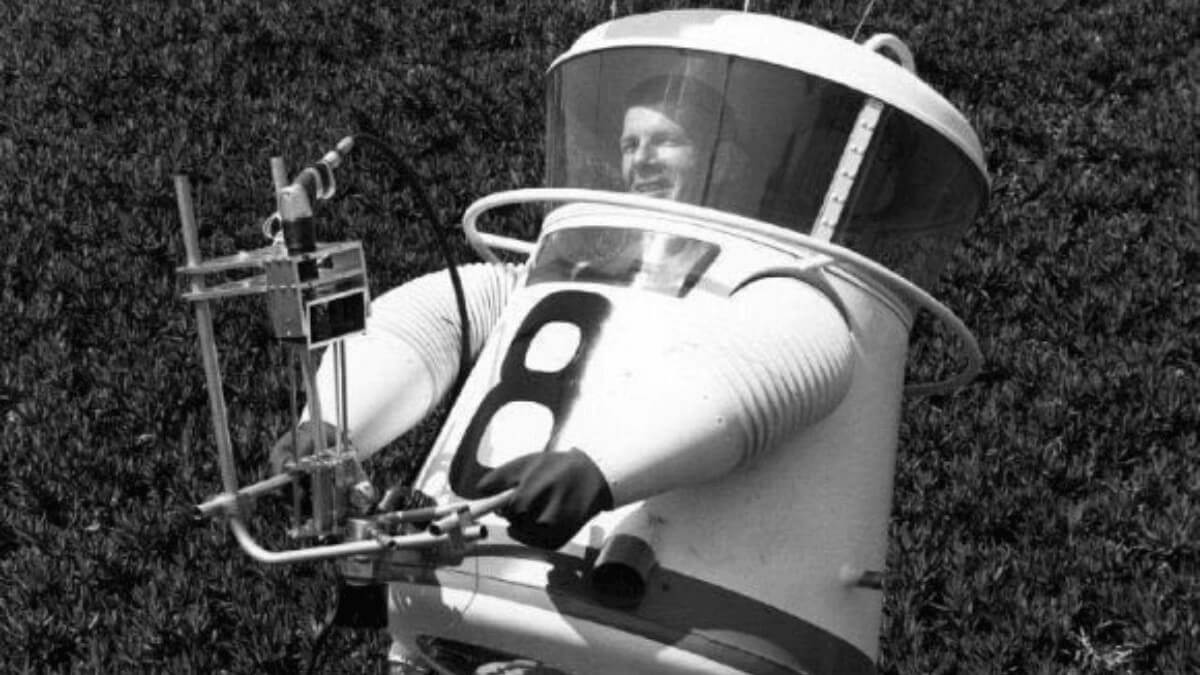
As spacesuit design continues to become thinner, more intricate, and more dynamic — there are touchscreen-sensitive gloves, an attached helmet, and built-in ventilation in the latest uniform — it’s worth looking at how both US and Russian spacesuits have evolved over time.
Start by looking at the original suit (the Marshmallow Moon-Suit) designed for the moon mission above, which was licensed to Mattel for toys, then check out the diagram detailing the history of suits below.
We still like the simplicity and balance of the Apollo A7-L EVA but the blue Apollo A5-L suit is also ace.


Naturally, there will be variations of spacesuit design especially as other companies invest into the future. For example, SpaceX is already working on its own version (see images below) while other patents, like an auto-return home button, should the astronauts become untethered, are also in development.
Who created the space suit?
Engineers, scientists, and designers collaboratively developed the modern space suit, which has seen multiple iterations since space exploration began. In the 1960s, the American company B.F. Goodrich created the first operational space suits for NASA’s Mercury program, basing their designs on those of NASA engineer Russell Colley.
For the Apollo missions, ILC Dover, then a division of Playtex, developed the A7L suits. These suits, tailored for the lunar environment, enabled astronauts like Neil Armstrong and Buzz Aldrin to walk on the moon.
In Russia, space suit development kicked off seriously in the 1960s. Yuri Gagarin wore the SK-1 suit during the first crewed spaceflight.
Are spacesuits hot, and how do they work?
Space suits are marvels of engineering designed to provide a livable environment for astronauts in extreme space conditions. They are not hot in the traditional sense; rather, they are built with thermal control systems to regulate the astronaut’s body temperature.
- Temperature Control: Space suits have built-in ventilation systems and liquid cooling garments that circulate temperature-controlled water around the body to regulate heat.
- Layers: Modern space suits consist of multiple layers, including thermal ones, to provide insulation against extreme temperatures. Space can be both extremely hot when exposed to direct sunlight and incredibly cold in the shade.
- Pressure Garment: Suits maintain a stable pressure around the astronaut, protecting them from the vacuum of space. This also prevents bodily fluids from boiling at the low pressures found in space.
- Oxygen Supply: Space suits have a life-support system to provide oxygen for breathing and to remove carbon dioxide and moisture.
- Mobility: Although quite bulky, the suits are designed to facilitate various movements, including walking, bending, and grasping objects.
What are the different spacesuit layers?
| Layer Name | Function and Features |
|---|---|
| Outer Layer | Serves as a shield against micrometeoroids. The first line of defense against harsh space conditions. |
| Thermal Layer | Designed for insulation, it protects astronauts from extreme temperatures, both hot and cold. |
| Pressure Garment | Stabilizes the internal environment of the suit, counteracting the vacuum of space and preventing bodily fluids from boiling. |
| Comfort Layer | The innermost layer, closest to the astronaut’s skin. Equipped with temperature-regulating features for optimal comfort. |
Spacesuit history: Mission and key features
| Spacesuit Name | Mission(s) Flown | Key Features and Notes |
|---|---|---|
| Mercury Suit | Mercury Program (1961-1963) | Developed by B.F. Goodrich; relatively simple pressure suit |
| Gemini Suit | Gemini Program (1965-1966) | Improved mobility; allowed for spacewalks |
| A7L | Apollo Missions (1969-1972) | Created by ILC Dover; enabled moon landings; first to use PLSS |
| Sokol Suit | Soyuz Missions (1973-Present) | Russian design; worn during launch, reentry, and docking |
| Orlan Suit | Various Russian Missions (1977-Present) | Russian design; allows for spacewalks; semi-reusable |
| Shuttle EMU | Space Shuttle Missions (1981-2011) | Modular design; multiple spacewalks possible; built by ILC Dover |
| ACES | Space Shuttle (1994-2011) | Known as the “pumpkin suit”; used for launch and reentry |
| Z-1 | Testing Phase | NASA’s prototype for next-gen planetary suits; highly flexible |
| Z-2 | Testing Phase | Follow-up to Z-1; enhanced durability and functionality |
| xEMU | Planned for Artemis Missions | Next-gen lunar exploration suit; enhanced mobility and life support |


Originally posted April 10, 2020, and updated on August 27, 2023.
Leave a comment