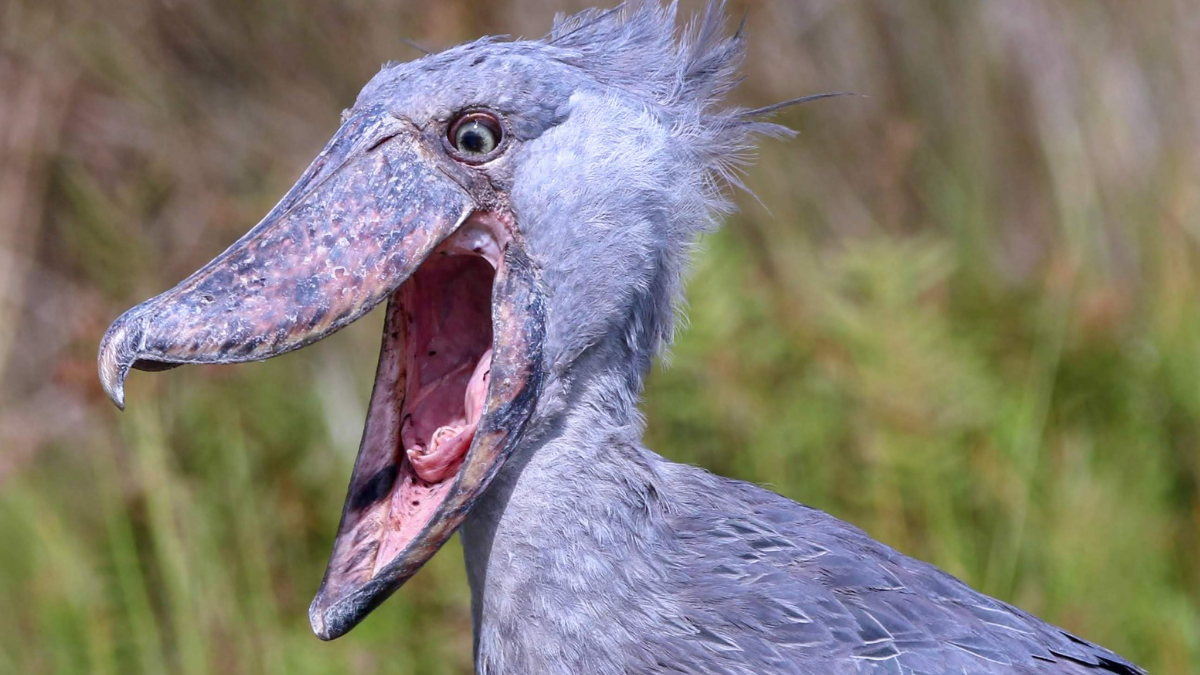
The shoebill stork, Balaeniceps rex, also called the whale-headed stork, is one of the most unsettling and surreal birds on Earth. Standing up to 5 feet tall with an 8-foot wingspan, it towers over the African wetlands it calls home. Its bill looks more like a worn wooden clog than a bird’s tool, and its piercing yellow eyes can stop you mid-step. It doesn’t move unless it has to. It just watches. Staring. Waiting.
This is not theatrics. It’s a hunting strategy. Shoebills feed on large fish, baby crocodiles, and water snakes. Their method: stand motionless for hours, then collapse forward in a brutal ambush. One lunge, one clamp of the hook-tipped beak, and it’s over. That unsettling stillness—the death stare—is evolutionary precision, not drama.
And yet it’s hard not to assign meaning to that gaze. The shoebill looks ancient because it is. Its lineage split off early from other birds. Though once misclassified as a stork, it’s now placed closer to pelicans and the hamerkop, its odd but far smaller cousin. Its internal anatomy and hunting behavior are more like a heron’s, but everything about its presence feels stranger, heavier, older.

Culturally, it’s both revered and feared. In parts of Uganda and South Sudan, its looming figure is sacred. In other areas, it’s considered a bad omen. Like the hamerkop, superstition may be what saves it. People leave it alone.
That helps, because the shoebill is elusive. Found in dense papyrus swamps across central and eastern Africa, from South Sudan’s Sudd to Zambia’s Bangweulu Wetlands, its habitat is disappearing. Fires, agriculture, oil exploration, and the illegal pet trade are constant threats. Conservationists have responded with creative solutions. In Bangweulu, former fishermen now patrol nests. In Uganda’s Mabamba Bay, canoe tours led by locals generate income from the bird’s fame. Communities see the bird not just as a curiosity, but as an asset worth protecting.

Then there’s Sushi. A shoebill at the Uganda Wildlife Education Centre who became internet-famous for bowing to visitors—if they bowed first. The comparison to a hippogriff from Harry Potter was irresistible. Sushi’s clip went viral. So did others: a shoebill clattering its beak like a typewriter, one flying in slow motion like a Jurassic holdover.
The memes are funny. The reality is more urgent. There are only a few thousand shoebills left. Their uniqueness is their best defense, and their biggest risk. Their sudden popularity has drawn attention to the trade in exotic pets. A chick can sell for over $10,000.
But there’s hope. Nest-guarding programs have fledged dozens of young birds. Hand-reared second-hatched chicks, which would usually die, are being released into the wild. In places like Bangweulu, people are beginning to see conservation not as charity, but as a shared investment.
No other bird blends goofy and gruesome like the shoebill. None moves so little or means so much. In a world where birds chirp and chatter, the shoebill glares back in silence. Its stillness is not emptiness. It’s survival. And maybe a warning.
Watch it long enough, and you start to wonder who’s really being studied.

Leave a comment