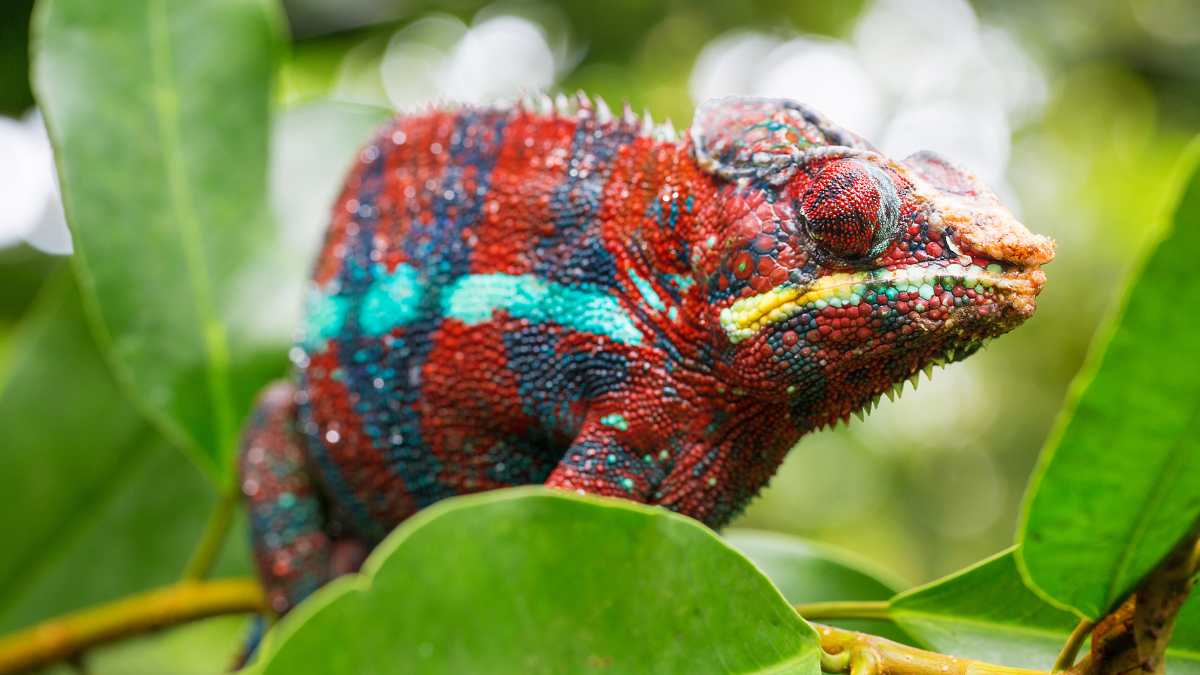
In the forests of Madagascar, a creature lives that doesn’t just wear color, it controls it. The panther chameleon (Furcifer pardalis) is one of the most visually spectacular lizards in the world.
Native to the eastern and northern coasts of Madagascar, it has become a favorite among biologists, pet keepers, and engineers alike. While most reptiles rely on pigment to define their skin color, the panther chameleon breaks the mold with its use of structural coloration—a mechanism based on nanocrystals rather than dye.

In the wild, different populations exhibit distinct color morphs, often defined by geographic locale. A chameleon from Ambilobe might flash reds and greens, while one from Nosy Be tends to glow with iridescent blues. These colors aren’t just for show; they’re deeply tied to territorial behavior, mating displays, and even emotional states.
Male chameleons are especially vibrant, using bold hues to attract mates or ward off rivals. Females, though more subdued in tone, undergo dramatic color shifts when gravid or defensive. It’s this living canvas of expression that makes the panther chameleon a subject of constant study.
A creature that commands color
The panther chameleon (Furcifer pardalis) is part artist, part engineer. It changes colors not to hide but to communicate, compete, and survive. And the more science delves into how it does this, the more it reveals a biological system so refined that it seems designed.
What looks like magic is actually physics. The chameleon’s skin contains layers of nanocrystals that reflect light at different wavelengths. When calm, those crystals are tightly packed, reflecting blues and greens. But when threatened, aroused, or ready to fight, the crystals loosen. The spacing widens. Suddenly, reds and oranges flare across its body. It’s color-shifting as real-time expression.
That shift isn’t random. It’s triggered by the chameleon’s nervous system and hormones. Think of it like a mood ring wired into its brain,a living visual language that signals aggression, submission, or romantic intent. Scientists are even exploring how these shifts tie into psychoactive neurochemistry.

Each eye moves independently. One scans for threats while the other lines up prey. When it strikes, the tongue launches faster than a jet engine, sometimes extending over twice its body length. The mechanics behind it,collagen springs and hydraulic precision,are now studied by roboticists trying to replicate that kind of speed and control.
But what makes the panther chameleon even more compelling is how it uses color as a social tool. In standoffs with rival males, it’s a contest of brightness and pattern. The most vivid often wins. Females, too, turn dark with bold warning stripes when gravid,a clear signal they’re off-limits.

Despite being listed as “Least Concern,” the species faces mounting risks: illegal poaching, habitat loss, and climate shifts that alter nesting conditions and food supply. Some now live in urban gardens or on power lines, adapting to fragmented environments. Others have popped up in Florida, likely escapees from the pet trade. It’s a reminder that adaptability cuts both ways.
The tech world is paying attention. Engineers are developing metamaterials that mimic the chameleon’s skin for radar cloaking, adaptive fashion, and military camouflage. Camera systems modeled on its eye movement could redefine how robots see and respond.
This isn’t just a colorful lizard. It’s a masterclass in biological engineering. One that sees the world differently, reacts faster, and wears its emotions on its skin.



Leave a comment