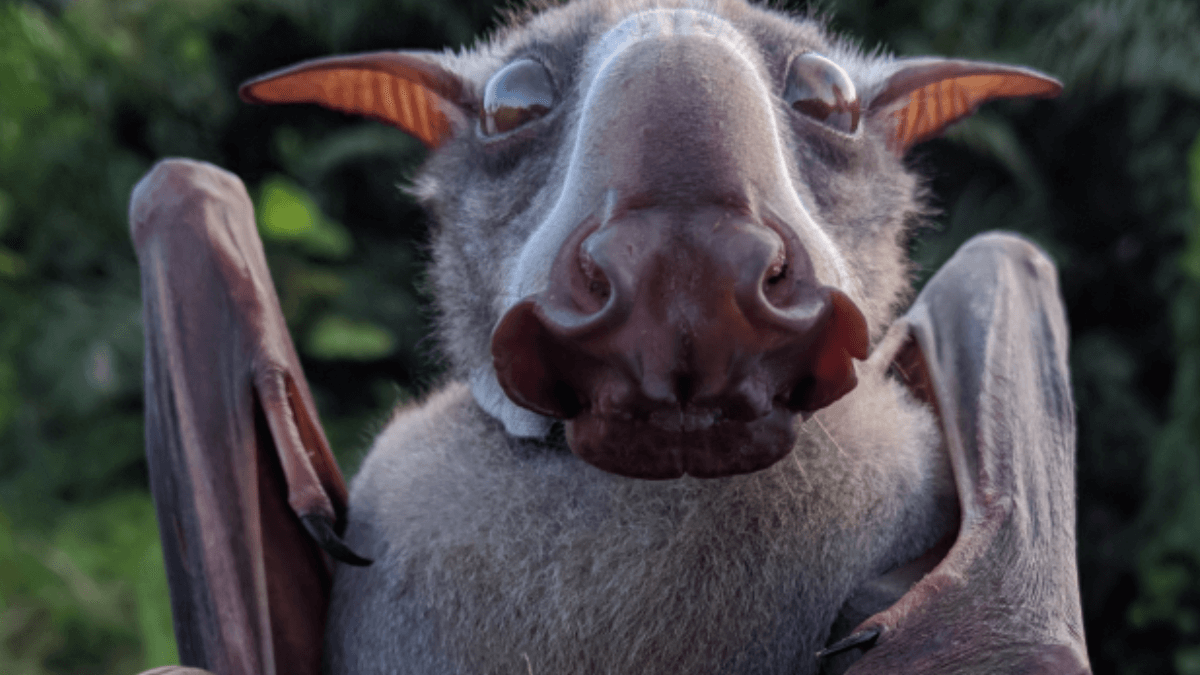
In the heart of Africa’s lush rainforests, a creature straight out of a fantasy novel takes flight. With a face that’s part horse, part kangaroo, and a wingspan that rivals some eagles, the hammerhead bat defies conventional notions of what a bat should look like.
These peculiar flying mammals, scientifically known as Hypsignathus monstrosus, have captivated the imaginations of scientists and nature enthusiasts alike, earning them the moniker of nature’s quirkiest airborne oddities.

By Sarah H. Olson ,Gerard Bounga,Alain Ondzie,Trent Bushmaker,Stephanie N. Seifert,Eeva Kuisma,Dylan W. Taylor,Vincent J. Munster,Chris Walzer – https://journals.plos.org/plosone/article?id=10.1371/journal.pone.0223139, CC0, Link
Meet the Hammerhead Bat
The hammerhead bat belongs to the family Pteropodidae. It’s a fruit-eating species that stands out even among its eccentric relatives. Males of this species are particularly noteworthy, sporting an enlarged rostrum that gives them their distinctive hammer-shaped head. This unique feature is absent in females, making the hammerhead bat one of the most sexually dimorphic bat species known to science.
A Face Only a Mother Could Love?
The hammerhead bat’s appearance is nothing short of extraordinary. With a wingspan that can stretch up to 1.5 meters (4.9 feet), it’s one of the largest bats in Africa. Their fur typically ranges from dark brown to black, providing excellent camouflage in the shadowy canopies of their forest homes. But it’s the male’s face that genuinely sets this species apart. The elongated snout and enlarged larynx create a profile that has drawn comparisons to everything from moose and horses to the fictional creatures of Star Wars.
While some may find their appearance unsettling, these bats play a crucial role in their ecosystem. Their fruit-based diet makes them important seed dispersers, contributing to the regeneration and diversity of African rainforests. As they flit from tree to tree, enjoying ripe fruits, they unknowingly plant the seeds of future forests in their droppings.
Masters of the Night Sky
Despite their bulky appearance, hammerhead bats are agile flyers. They easily navigate the complex forest environment, using echolocation to find their way and locate food. Their large size allows them to cover considerable distances, making them effective pollinators and seed dispersers across vast areas.
During the day, these bats roost in trees, often in large colonies. However, researchers have noted an interesting behavior: hammerhead bats tend to isolate themselves from the group when stressed. This social flexibility may adapt to life’s challenges in the ever-changing rainforest environment.
A Unique Mating System
One of the most fascinating aspects of hammerhead bat biology is their mating system. They are thought to be the only bat species that employs a classical lek mating system. During breeding, male hammerhead bats gather in specific areas, often along riverbanks, to compete for female attention.
In these leks, males produce loud, honking calls that can be heard from great distances. The enlarged larynx and resonating chambers in their hammer-shaped heads amplify these vocalizations, creating a cacophony of sound in the forest. Females visit these leks and choose their mates based on the quality of their calls and displays.
This system is highly competitive, with studies suggesting that only about 6% of males account for nearly 80% of successful matings. This intense sexual selection likely drives the evolution of the males’ extreme facial features and vocalizations.
Conservation Concerns
Despite their adaptability and wide range across Central and West Africa, hammerhead bats face several threats. Habitat loss due to deforestation is a primary concern, as these bats rely on intact forest ecosystems for both food and shelter. Additionally, they are hunted for bushmeat in some areas, putting further pressure on their populations.
The hammerhead bat’s role as a potential reservoir for zoonotic diseases, including Ebola, has also complicated conservation efforts. While this association has led to fear and misunderstanding among some human populations, it underscores the importance of maintaining healthy ecosystems and minimizing human-wildlife conflict.
Conservation initiatives focusing on protecting tropical rainforests and educating local communities about bats’ ecological importance are crucial for ensuring the long-term survival of hammerhead bats and the ecosystems they support.
In conclusion, the hammerhead bat is a testament to our planet’s incredible diversity of life. From their bizarre appearance to their unique behaviors, these flying mammals fascinate and surprise us. As we work to protect the world’s biodiversity, let’s not forget quirky, unusual, and downright strange creatures like the hammerhead bat.
Learn more about bat conservation efforts
Photo: Wikimedia/Enwebb, Sarah H. Olson




Leave a comment