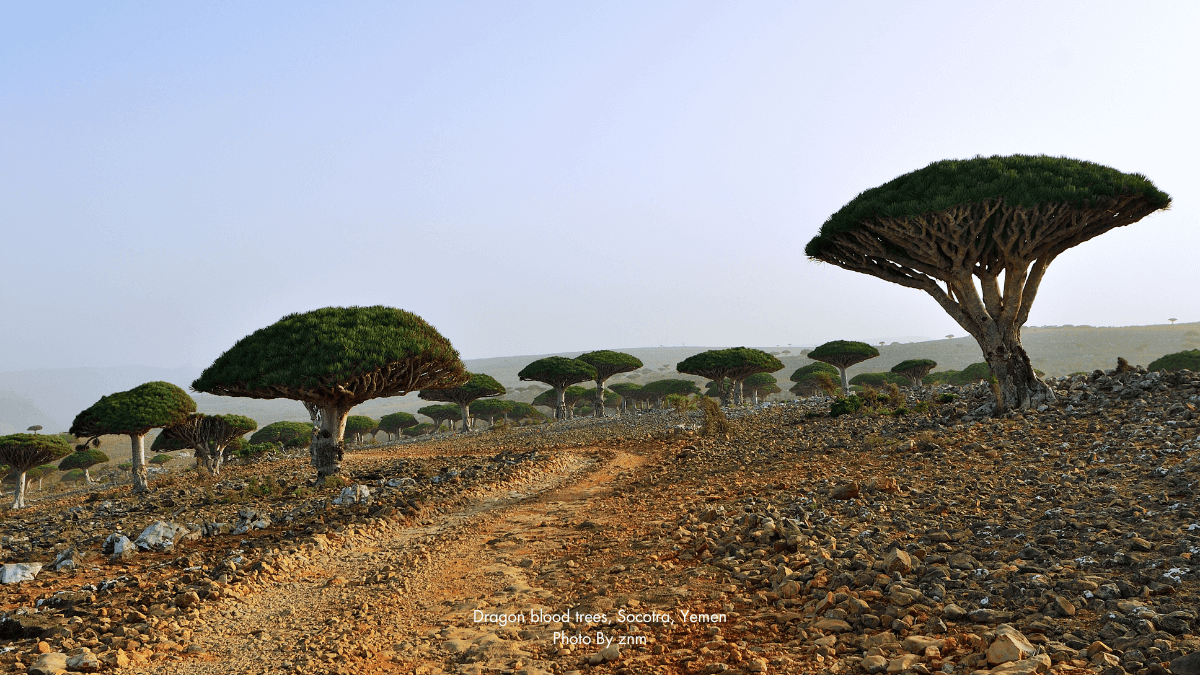
The Socotra archipelago sits off the coast of Yemen in the Arabian Sea. It’s an isolated realm with harsh winds and towering limestone plateaus.
Yet one living icon truly commands attention here: the Dragon Blood Tree (Dracaena cinnabar). With stout trunks and umbrella-like crowns, these ancient monocots look otherworldly.
Explore more on Dragon Blood Trees to see why locals have cherished them for centuries.
When cut, they bleed a crimson resin, inspiring the local Arabic name, “Damm Al-Akhwayn,” or “blood of two brothers.” But contrary to what you might believe, dragon blood is NOT dangerous. Here’s why.

By Sharktopus – Own work, CC BY-SA 3.0, Link
Early sailors once called Socotra a land of magicians and mythical creatures. Today, botanists confirm that the island’s ecosystem is indeed special.
More than a third of its 800-plus plant species exist nowhere else on Earth. The Dragon Blood Tree is among the most vulnerable and is classified as endangered.
It faces threats from climate shifts, reduced monsoon rainfall, and goat herds that graze on seedlings.
.jpg#/media/File:Dragon's_blood_(Daemomorops_draco).jpg)
By Andy Dingley – Own work, CC BY-SA 3.0, Link
Some estimates project that nearly half its habitat could be lost by 2080 if conditions continue to worsen. Even so, many Socotris remain committed to protecting this living relic.

A Sap Once Believed to Be Magic
The tree’s resin has captured human imagination for centuries. In the 18th century, people sold it as toothpaste and folk medicine.
Older texts describe it as a potent dye, valued for varnishing violins and coloring fabrics. Some farmers still “bleed” the trees by carving small notches in the bark and collecting the thick, red sap. They use it as an ingredient in balms and incense.

One Socotri guide notes that the resin has “healing qualities greater than Mumiyo,” referencing another natural remedy in the Middle East. However, overharvesting can harm the population if done irresponsibly.
Cultural tales merge with scientific curiosity when it comes to Dragon Blood Trees. Scottish botanist Isaac Bayley Balfour documented them as far back as 1882. Older Yemeni coins once bore their image, reflecting their historical importance.
Many Socotris insist these trees are bound to local beliefs and language. The Soqotri tongue predates Arabic, and words tied to the sap and geology reveal a deep cultural tapestry.
A Fragile Lifeline in a Changing Climate


Like a natural sculpture, the Dragon Blood Tree’s canopy channels fog and drizzle down its trunk, delivering precious water to the root system in Socotra’s arid conditions.
Even so, young trees can struggle in overgrazed areas or during prolonged drought. Conservationists say that while some sanctuaries have expanded, long-term measures remain crucial.
Goats often browse on seedlings, preventing them from forming that iconic umbrella shape. Fluctuating monsoons only add more pressure, reducing overall regeneration.
Yet the Dragon Blood Tree isn’t dangerous, despite questions from curious travelers. Locals reassure visitors that its crimson sap isn’t toxic or harmful.
In traditional medicine, people have used Dragon Blood to treat wounds and skin irritations. Others mix the powdered resin with natural oils to create ointments or lipsticks. Centuries ago, the resin was sold in global markets and was believed to hold near-magical potency. Now, you can find it on Amazon.
Today, although conflict in mainland Yemen has complicated tourism, Socotra still draws adventurous ecotourists. Any traveler privileged enough to glimpse those mushroom-like canopies in person might find the view surreal.
For many, that first sight of a Dragon Blood Forest against Socotra’s jagged mountains underlines how delicate our planet can be. Even as the world grows more connected, these remote forests stand guard over an ancient story shared by the local people and the trees themselves.
Leave a comment