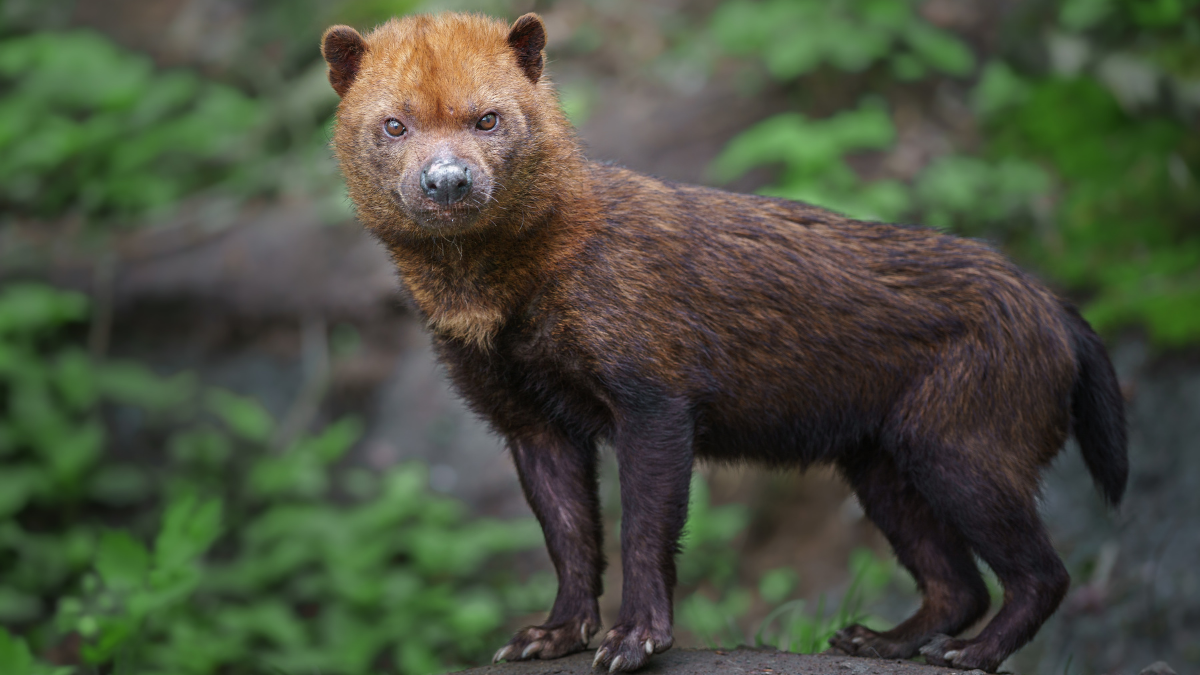
You’d be forgiven for thinking the bush dog is a hoax. Rarely seen and once known only from fossils, it spent decades slipping through the cracks of modern science. For much of the 20th century, many biologists believed it had vanished from the planet altogether.
But the bush dog, Speothos venaticus, is very much alive. And it may be one of the strangest predators in the Americas.
It looks like a miniature bear, acts like a wolf, and thrives where land meets water. Its feet are webbed. Its fur smells like vinegar. And even though it stands barely a foot tall, it’s been documented taking down animals as large as capybaras.
These aren’t isolated quirks. The more scientists study the bush dog, the more extraordinary it becomes.

Small bodies, big coordination
Bush dogs don’t rely on stealth or solitude. They rely on each other.
Packs of six to ten roam through forests and flooded savannas, communicating in high-pitched peeps as they hunt. They work together mostly by day, using a river or stream to trap their prey.
One group flushes an animal from land. Others wait in the water. The webbed feet kick in, and the kill is shared.

These dogs can bring down prey much larger than themselves—peccaries, brocket deer—and they also target agoutis, pacas, snakes, and ground birds. When pups are born, the entire pack helps raise them.
It’s a level of coordination more familiar to African wild dogs than to anything else this small.
A ghost across continents
Bush dogs range from the Amazon basin to northern Argentina. They prefer dense, wet forests and river corridors but have also turned up in scrublands and fragmented farmland.
For years, scientists thought their northern limit was Panama. But in 2016, camera traps in Costa Rica’s Talamanca Mountains caught something surprising: first a lone bush dog, then an entire pack. The elevation? Over 6,000 feet—far higher than anyone expected.
Local Bribri communities had long spoken of a strange wild dog. Now researchers had proof.

Sightings in Paraguay, Peru, and urban edges of Brazil soon followed. Most bush dogs still move beneath notice. In some places, even park rangers have never seen one.
That low profile may be part of how they’ve lasted. But it also makes them harder to protect.
A shrinking, silent stronghold
Bush dogs are listed as Near Threatened by the IUCN and are protected in much of their range. But laws don’t help if no one knows the dogs are there.
Their numbers are falling. Deforestation, agriculture, and roads continue to shrink and split up their habitat. Disease from unvaccinated domestic dogs—distemper, parvovirus—can wipe out an entire pack in one outbreak.
Their prey is vanishing too. Capybaras, armadillos, and pacas are often hunted for bushmeat. When they go, the bush dog’s world begins to collapse.
Even so, there’s hope. Detection dogs have tracked bush dog scat across Argentina, Brazil, and Colombia, helping conservationists identify core habitats and plan wildlife corridors.
Each camera trap photo is another sign: of survival, of adaptation, of a species still holding on.
The bush dog, once a rumor, is revealing itself. Quietly. Skillfully. And perhaps just in time.
Leave a comment