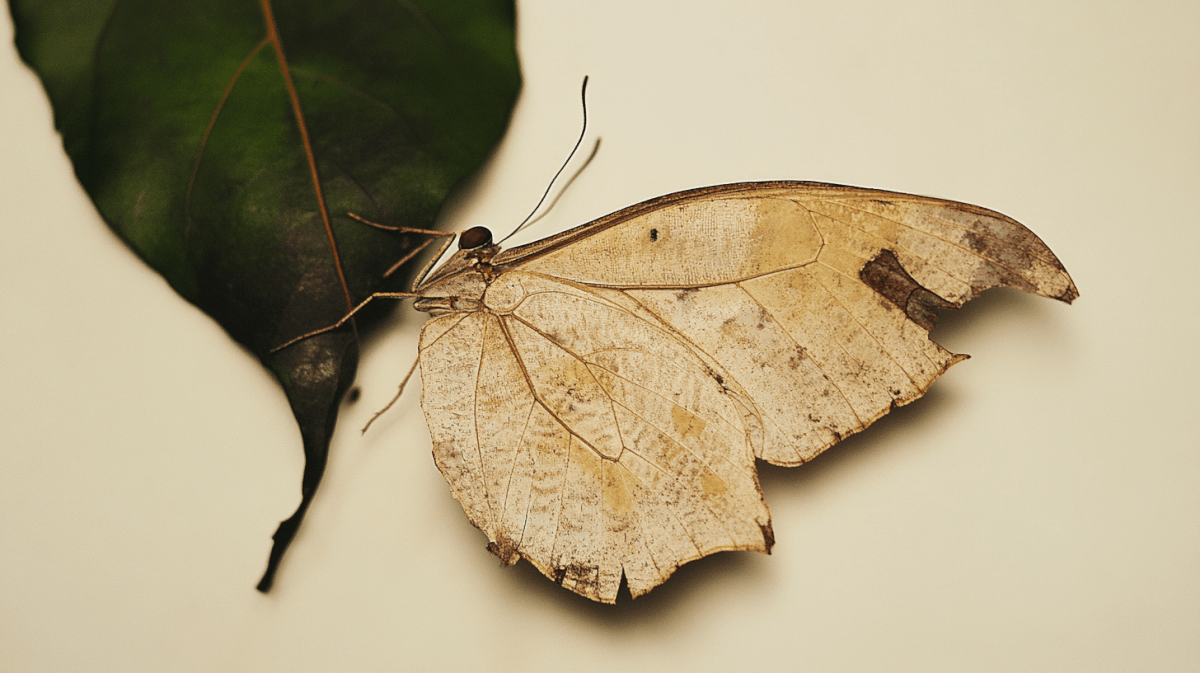
The Dead Leaf Butterfly, scientifically known as Kallima inachus, is one of nature’s most extraordinary creatures. Renowned for its incredible mimicry, this butterfly’s ability to resemble a dry, dead leaf is a testament to the wonders of evolution. Here are five fascinating insights into this natural wonder.
1. Masters of Disguise

The Dead Leaf Butterfly is unrivaled in its ability to blend seamlessly into its environment. When its wings are closed, the intricate patterns mimic a dry leaf’s veins, textures, and even the irregular edges. These details create such a convincing disguise that predators like birds often overlook them entirely, mistaking the butterfly for a piece of forest debris. The butterfly enhances this illusion, making it nearly invisible by remaining motionless among leaf litter,
2. Dual-Purpose Wings

While the underside of the butterfly’s wings is all about camouflage, the upper side tells a different story. When spread open, the butterfly reveals vibrant hues of orange and blue. This striking contrast serves two purposes: it can startle predators, providing a chance to escape or attract mates. The dual nature of its wings showcases an ingenious balance between concealment and display, tailored to survival and reproduction.
3. Found in Tropical Asia
Native to the tropical forests of Asia, the Dead Leaf Butterfly thrives in regions such as India, Southeast Asia, and Japan. Its natural habitat includes dense vegetation and forest floors, where its camouflage is most effective. However, these butterflies are adaptable and can be spotted in gardens and subtropical environments. Their ability to blend into various surroundings underscores their evolutionary success in diverse habitats.
4. Mimicry Across Life Stages
The Dead Leaf Butterfly’s mastery of mimicry extends beyond adulthood. In the caterpillar stage, the larvae feed on leaves and blend into their surroundings to avoid predators. During the chrysalis phase, the transformation cocoon itself resembles a dead leaf, providing additional camouflage. This mimicry at every stage of life ensures higher survival rates, making the species a remarkable example of adaptation.
5. A Testament to Evolution
The Dead Leaf Butterfly’s disguise is not random but a result of thousands of years of natural selection. Its wing patterns are so detailed that they often include spots resembling decay or fungus, further enhancing the illusion. This ability to imitate the subtle nuances of dead leaves highlights the intricate interplay between biology and the environment. It is a vivid reminder of how species evolve to thrive in the wild.
Quick Facts About Dead Leaf Butterfly

Habitat and Distribution
- Preferred Environments: Thrives in tropical and subtropical regions, primarily in dense forests with abundant vegetation. These areas provide:
- Dense foliage for predator protection.
- High humidity to maintain delicate wing patterns.
- Host plants essential for feeding and egg-laying.
- Geographical Range: Found in Southeast Asia (India, Malaysia), parts of Africa, and South America, relying on specific ecosystems with suitable climates and host plants.
Unique Physical Characteristics
- Camouflage Techniques: When wings are closed, it mimics a dead leaf with veins and edges resembling natural foliage, blending seamlessly into the forest floor to avoid predators.
- Wing Patterns: The upper sides reveal bright colors (orange, blue, purple) used for attracting mates and startling predators, contrasting with the camouflaged underside.
Leave a comment