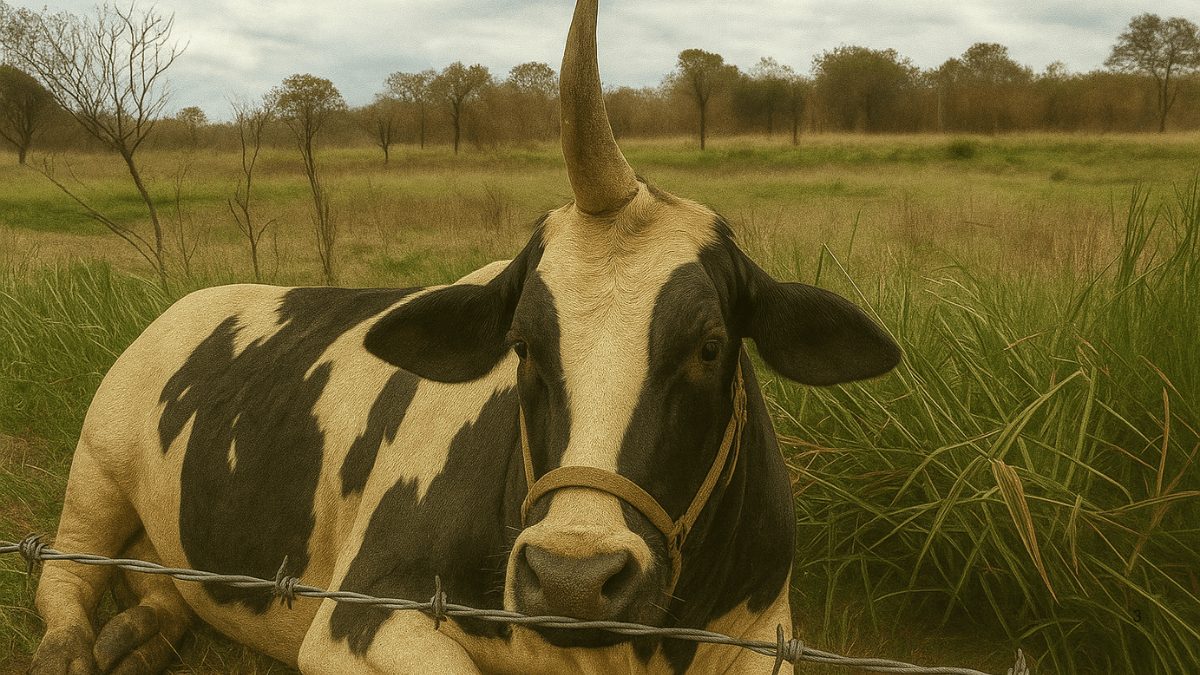
It starts with a photograph. A tan cow stands in profile, gazing toward the camera, with one impossible detail: a single, clean horn rising from the center of its forehead.
It looks like something out of a fairytale, or maybe Photoshop. But it’s not.
These animals exist. They’ve been born in Canada and Uzbekistan, spotted in Uganda and Brazil, and even toured with the circus in the United States.
While the internet loves to joke about “real-life unicorns,” the truth behind these one-horned cows is even stranger and more fascinating than legend.

Born or built: the science and myth behind one-horned cattle
In most cows, horns grow from two separate buds on either side of the skull. But sometimes, because of a rare congenital mutation, that symmetry is disrupted.
The horn buds might fuse or shift, forming a single horn near the center. Some calves even sprout a third horn right in the middle of the forehead, just like the photos show.
One of the most well-documented cases happened on a Canadian farm, where a Simmental heifer grew a third horn straight out of her forehead. At birth, it was just a soft bump.
Within months, it hardened into a full spike. The family kept the calf, not just because of the novelty, but because the horn didn’t seem to hurt or hinder her.
She grew into a healthy, dominant cow. A similar case appeared in Uzbekistan, where a “unicorn” calf used its extra horn to boss around the rest of the herd.

In Brazil, a viral video showed a one-horned cow (or ox, a male member of the cattle family) calmly grazing in a field, its central horn unmistakable. These are real animals.
They aren’t a new breed, just rare outcomes of biology. But not all unicorn cows are born this way.
Some are shaped by human hands. In the 1930s, a biologist named W. Franklin Dove asked a simple question: could you create a unicorn?
His method was bold. He removed a day-old calf’s horn buds and surgically grafted them to the middle of its forehead.
Within two years, the bull had grown a massive single horn. Dove noted that the animal quickly realized its new power.
It didn’t need to fight. One look at the horn, and the other bulls backed off.
The experiment worked so well that Dove tried it on goats. Decades later, a California couple pushed the idea further.
In the 1980s, Oberon and Morning Glory Zell bred white goats and relocated their horn buds to the center. The result was a small herd of living unicorns, complete with flowing manes.
One of them toured with the Ringling Bros. circus under the tagline, “Seeing is Believing.” Some critics raised ethical questions.
But the Zells said the procedure was painless when done on newborns, and no more invasive than the standard dehorning done on most farms. Still, it sparked debate about what happens when humans reshape nature to fit a myth.
What makes unicorn cows so irresistible might not be the horn itself. It’s what they represent.
They remind us that nature can still surprise us, even in an age of lab reports and high-res scans. They blur the line between folklore and flesh.
And sometimes, they show what happens when human imagination collides with a living body.
Leave a comment