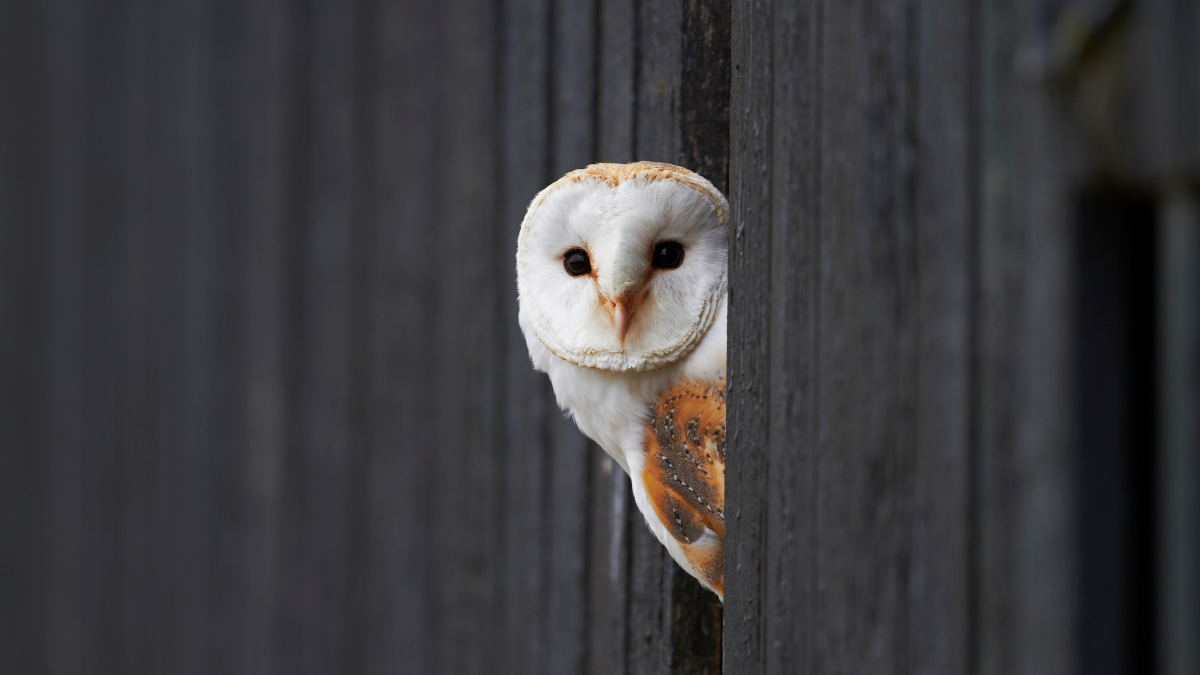
Barn owls are nature’s stealth engineers. In the dark, they patrol the night sky with eerie stillness, their wings whispering through the air as they home in on unseen targets.
Every part of their body is tuned for one purpose: to turn sound into a precise, silent strike. This is more than instinct; it’s a finely evolved system that rivals human-made technology.
Their heart-shaped facial disc, composed of specially structured feathers, acts as a sound collector that funnels and focuses prey noises toward the ears. Beneath this acoustic funnel lies a startling asymmetry: the left ear sits slightly higher than the right. This design allows the owl to hear in three dimensions, pinpointing both distance and elevation of the tiniest rustling creatures.

The wings are equally remarkable. Microscopic comb-like serrations on the leading edge and a soft, velvety fringe along the trailing edge serve as acoustic dampeners. These structures break up airflow turbulence and drastically reduce sound, to levels below the hearing range of their prey. With enormous wings relative to body mass, barn owls can glide slowly, sometimes at just two miles per hour, allowing for surgical stealth.
Experiments confirm that barn owls can locate and capture prey using only their hearing, even in complete darkness. When vision is unavailable, they tilt their heads and adjust their position until the sound reaches both ears simultaneously, then they strike. Removing parts of their facial ruff impairs their ability to determine prey elevation, though horizontal directionality remains intact.
By weight, barn owls consume more rodents than perhaps any other predator. Up to 95 percent of their diet is made up of mice, voles, and shrews. They may eat nearly a quarter of their body weight in prey each night. Excess kills are sometimes cached for lean times.
These adaptations come with costs. Unlike many birds, barn owls are not waterproof. Their specialized feathers do not repel moisture, so hunting in rain risks damp plumage that muffles hearing and flight, and can even cause drowning. Once, old barns provided indoor refuge during storms, but fewer structures now leave them more exposed.
Barn owls are among the most widespread land birds in the world. Yet in some regions, superstition and habitat loss threaten their survival. They play a vital role in controlling pests around farms, offering natural rodent regulation without chemicals.

Silent mastery of sound
Barn owls hunt where few others dare: the pitch-black hours of night. Instead of relying solely on eyesight, they use sound. Their facial disc and offset ears create a biological radar, mapping movement in near-total darkness.
Combined with silent flight, these adaptations enable them to position, swoop, and snatch prey without warning. It is a system honed for precision. You do not see the owl coming. You only feel the strike.
Despite their elegance, they are at risk. With fewer barns and buildings to shelter in, and superstitions still fueling persecution, these birds deserve protection. Promoting barn owl boxes and preserving nesting sites help keep pest control natural and humane.
Their hunting technique offers more than wonder; it inspires human engineering. Acoustic technologies and noise-reducing aerodynamics borrow from the same features that let these owls glide silently through air and soundscapes alike.
Leave a comment