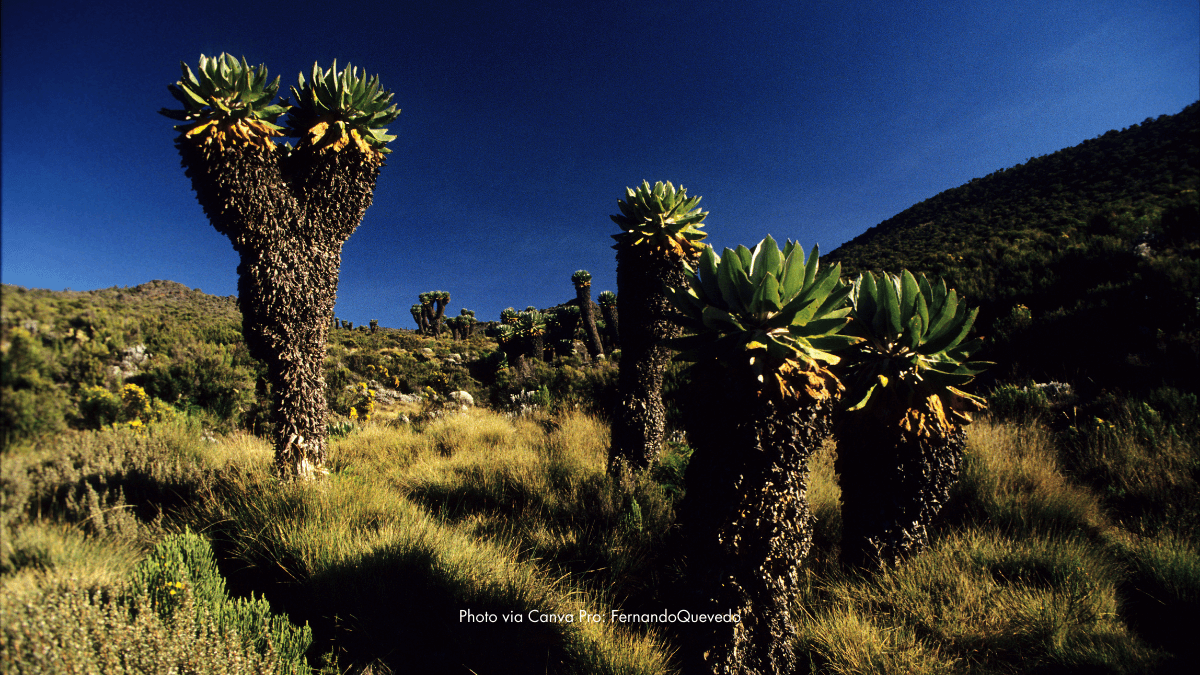
They don’t look like anything you’d expect to find on Earth, but you’ll see them as soon as you step into Kilimanjaro’s high moorland: towering rosettes with thick stems that store water like living canteens.
These giants are Dendrosenecio Kilimanjaro, the Kilimanjaro giant groundsels. They’re only found between about 10,000 and 13,000 feet on the mountain’s slopes. Hikers often describe them as spiky pineapples perched on wooden poles, made all the more surreal by the extreme environment they call home.
You’ll enter this landscape after leaving the misty forest belt behind. Each day you climb, it’s almost like passing through separate worlds, from steamy rainforests to high-altitude desert and, finally, the icy summit.
Beautiful finding on the mountain. The flora on Mt. Kilimanjaro is inimitable. Also, the guides use the Giant Groundsels as indicators, where there’s a groundsel – source of water is nearby. The wilted leaves don’t fall off, they protect the plant giving it warmth. https://t.co/uvQyga5WCK pic.twitter.com/XPXTPaMGp4
— Zuweina Farah (@Zuw508) September 8, 2020
Above the Clouds, Beyond the Ordinary
— Kilimanjaro Unforgettable (@Kilimanjarounfo) March 12, 2025
Welcome to the magical world above the clouds. This is the unique landscape of Mount Kilimanjaro, where towering giant groundsels stand as nature’s masterpiece. pic.twitter.com/7VENyB5nOq
The giant groundsels thrive in that transitional moorland, soaking in sunlight by day and surviving near-freezing nights by bundling their leaves for warmth. Some call these mountains “islands in the sky,” because they’re so isolated that unique species, like the groundsel, had millions of years to adapt in ways found nowhere else.
A Plant Like No Other
Dendrosenecio kilimanjari grows slowly, sometimes just a few centimeters a year, which means many specimens you see might be hundreds of years old.
Dendrosenecio kilimanjari is the apothesis of Kilimanjaro’s unique biodiversity. One look at these plants tells a story of adaptation to an extreme cycle of “summer every day, winter every night,” as described by botanist Olof Hedberg. When night temperatures dive below freezing, the groundsel’s old leaves wrap around the trunk for insulation, while fluid stored in its stem helps ward off frost damage.

They share this Afro-alpine zone with other unusual species like giant lobelias, all of them forming an ecological community designed to handle dramatic temperature shifts.
Scientists believe giant groundsels evolved from a relatively ordinary ancestor at lower altitudes and inched higher up the slopes over millennia, aided by windborne seeds and the mountain’s slow but steady geological changes.

Once they arrived in these upper regions, their survival depended on a thick stem for water storage and a nightly ritual of folding leaves.
Keeping the Future in Sight
Today, these prehistoric-looking plants face new pressures. The tourism boom on Kilimanjaro brings valuable resources to local communities, but it also means increased foot traffic.
Path erosion and the temptation for off-trail exploration can threaten slow-growing species. Thus, it’s vital to take great precaution to ensure these plants survivability. Trekkers are urged to stay on marked paths and respect the delicate balance that took centuries to form.

In truth, these giant groundsels are a reminder that Kilimanjaro is far more than just a bucket-list summit. Their presence marks a singular triumph of evolution, a glimpse into how life finds a way in what seems like impossible terrain.
For climbers lucky enough to pass through the moorland, it’s a sight that lingers, reminding us all that nature, given the time and space, can create wonders beyond expectation.
Leave a comment