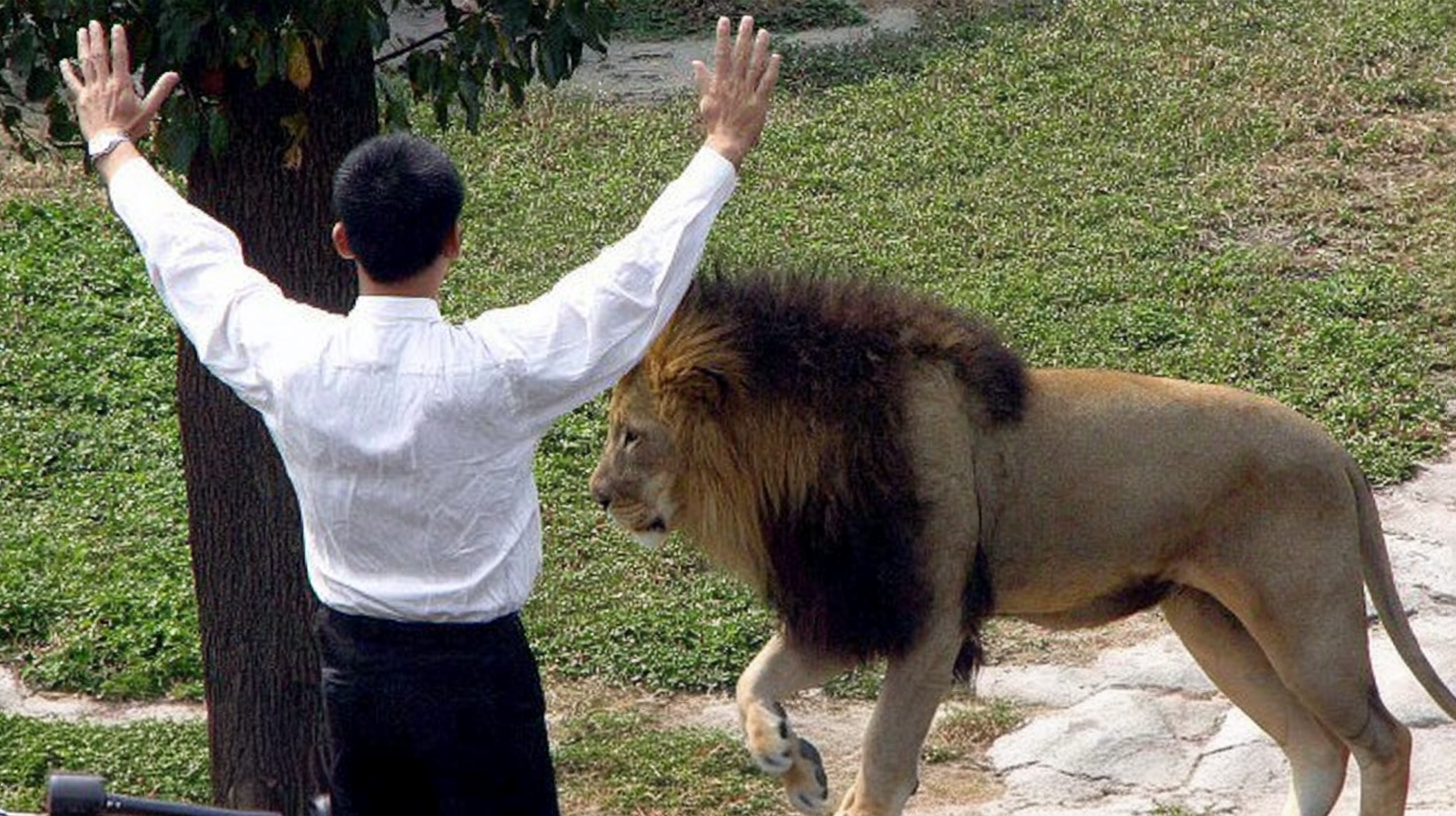
On a warm November morning in 2004, families drifted past the lion exhibit at Taipei Zoo, pausing to watch a male and female lion lounging in the shade. Then a man climbed over the barriers and began walking toward the cats with a Bible in his hand.
Some visitors thought it was a stunt. Others assumed he was a keeper. But when he stopped in front of the lions, raised his voice, and shouted that Jesus would save them, the illusion snapped. Within minutes, the male lion charged.
Nearly twenty-one years later, the story of Chen Chung-ho still resurfaces online in headline form: the Christian who threw himself to the lions and somehow lived. But beneath the viral framing is a far more complicated story about mental health, faith, and how wild animals get pulled into human dramas they never asked for.
1. The morning a man walked into a lions’ den
On November 3, 2004, Taipei Zoo was hosting visiting zoo officials from around the world. The lions’ exhibit, a concrete pit lined with rockwork and trees, sat behind multiple barriers: walls, a flower bed, fencing, and a drop into the enclosure.
Sometime late in the morning, a 46-year-old man in ordinary clothes climbed over the public fence. He crossed a planted area, got past wire mesh, and scaled the rock wall that separated the viewing area from the lions. Then he jumped several meters down into the habitat.
Visitors screamed. A mother yanked her son back from the railing. The male lion rose first, mane catching the light, and turned his head toward the man now standing in his territory. The female followed.
Chen kept walking, Bible in one hand.
2. How belief, drugs, and illness intertwined
To bystanders, what happened next looked like pure religious fervor. Chen stood in front of the lions and shouted that Jesus would save them. He waved his jacket, called out to the animals, and according to multiple reports even taunted them to bite him.
Chen had been struggling with heavy drinking and amphetamine use for years. In the months leading up to the incident, his family noticed a sharp change. He spoke about seeing ghosts. He heard voices. His thinking became fragmented and grandiose.
Around the same time, he began attending a Christian church, hoping to break his addictions. For a man already teetering on the edge of psychosis, the story of Daniel in the lions’ den was a potent script: a righteous believer thrown among lions, spared by divine protection.
By the morning he walked into the enclosure, Chen was high, withdrawing, or both. Later he would say that he was drinking and using drugs daily and that his thoughts no longer lined up with reality. In that altered state, re-enacting Daniel’s ordeal did not feel suicidal. It felt like a brutal test of faith he was meant to pass.

3. What the lions actually did
From the lions’ point of view, a stranger had just entered their territory, shouting and gesturing.
At first, both cats hesitated. They stood, watched, and approached slowly, ears forward, as if trying to make sense of the unusual intruder. Chen took off his jacket and waved it. He moved closer rather than backing away.
The male lion closed the distance.
In the video that circulated later, the lion lunges, hooks Chen’s jacket in its jaws, and yanks it free. A heartbeat later, it bites his arm. Chen stumbles back onto a rock ledge, arms raised in a posture that could read as surrender, prayer, or both.
Instead of fleeing, he stays put.
The male lion bites again, this time catching his leg. The female hovers nearby. The attack is violent, but oddly restrained. The lions do not drag him down and kill him. They bite, release, and pace. One possible reason, mentioned in local reports: they had been fed earlier in the day.
To spectators, it looks like a miracle. To keepers, it looks like two big cats reacting defensively to a confusing threat, not hunting.
4. The rescue that spared both man and animals
Once Chen dropped into the pit, the zoo’s emergency protocols kicked in fast.
Security guards cleared the crowd back from the viewing edge. Veterinarians grabbed tranquilizer rifles and blowguns. Firefighters arrived with high-pressure hoses. Police officers took up positions with live ammunition in case the lions could not be stopped any other way.
The plan centered on two tools most big cats hate: needles and water.
Keepers fired tranquilizer darts at the male lion. Some shots missed in the chaos. While the sedatives began to take effect, firefighters opened the hoses, sending sheets of water arcing into the enclosure. The streams created a moving barrier between the lions and the man, pushing the cats back without injuring them.
As the drugs finally took hold, the male staggered toward an inner holding area and the female lay down. Only then did staff risk entering the pit. They reached Chen, who was now bleeding and clutching his leg, and carried him out on a stretcher.
He was rushed to a nearby hospital with deep bite wounds to his arm and thigh but no life-threatening injuries. The lions were monitored in the zoo’s animal hospital until the tranquilizers wore off. No bullets were fired.
5. What happened to Chen after the attack
The dramatic images from the zoo traveled quickly through news wires. The harder, quieter work happened afterward in a hospital ward.
Doctors cleaned and stitched Chen’s wounds. Surgeons closed the gash in his leg. Once his physical condition stabilized, psychiatrists stepped in.
Chen arrived at the hospital mumbling religious phrases, talking about suffering and paying tribute to the lions. He described hearing voices. His family reported weeks of strange behavior leading up to the incident.
Psychiatrists diagnosed an acute manic or psychotic episode, likely fueled by years of alcohol dependence and amphetamine use. Instead of jail, Chen was transferred to a psychiatric facility and then to a rehab program.
There, away from the cameras, he slowly sobered up. In later interviews with Christian media, he described his life before the attack as a blur of gambling and drugs, and the lions’ den as a turning point he barely understood at the time. He said he eventually got clean and stayed that way.
That version of Chen, years out from the pit, is not the wild-eyed figure in the viral footage. He is a middle-aged man reflecting on how close he came to dying in front of two confused lions and a packed viewing platform.
6. Other people who stepped toward predators
In the early 1990s in Nigeria, a self-proclaimed prophet named Daniel Abodunrin entered the lions’ cage at a zoo in Ibadan, reportedly trying to demonstrate that he, like the biblical Daniel, would be protected. The lions killed him in front of witnesses.
In 2016 in Santiago, Chile, a young man climbed into a lion exhibit, stripped off his clothes, and shouted apocalyptic phrases. Zoo staff, faced with a mauling in progress and no time for tranquilizers, shot and killed two lions to save him. He survived with severe injuries.
In New York in 2012, a man jumped into a tiger enclosure at the Bronx Zoo, later telling investigators he wanted to be “one” with the animal. He was mauled but lived.
These stories share a few traits. They involve people in obvious distress, often mixing spiritual language with suicidal or grandiose thinking. They require determined effort to bypass barriers. And they leave captive animals paying the price for human behavior, whether through stress, bullets, or being framed as villains.
7. What psychologists see in cases like this
Substance dependence changes brain chemistry and decision-making. Psychosis makes hallucinations and delusions take on the texture of reality. And in many cultures, scripture and spiritual stories are the most available language for grand ideas.
When people in a psychotic state reach for meaning, they often grab the most powerful stories around them. For some, that might be espionage or government conspiracies. For others, it’s angels, demons, and miracle tales.
The Daniel story is ready-made for this kind of appropriation. It centers on a believer thrown among lions, spared by divine intervention. In a healthy context, it’s a metaphor about faith under pressure. In untreated mental illness, it can morph into an actionable script: go find lions, prove your faith, and you will be safe.
Chen’s brain, scrambled by drugs and illness, convinced him he was living inside a miracle story and that normal rules—like “lions will maul you”—no longer applied.
8. Faith, scripture, and the danger of literal tests
Religious leaders who reflected on the Taipei incident were quick to draw a line between spirituality and spectacle.
The Daniel story is not an instruction manual. Daniel doesn’t seek out the lions. He’s thrown into the den by an imperial decree. The miracle isn’t in the setup; it’s in the survival.
Most religious traditions also include strong warnings about testing God on purpose. In Christian scripture, the idea of deliberately manufacturing danger to force divine action is explicitly rejected.
What happens in cases like Chen’s is less theology than appropriation. A mind in crisis pulls a dramatic scene from a sacred text and turns it into a personal dare. The lions become props in a one-man play that nobody else auditioned for.
A man whose life was unraveling under addiction and psychosis walked into a place designed to be impossible to enter. Two captive lions responded in a way that was violent but not total. A group of keepers, firefighters, and police managed to improvise a rescue that saved everyone involved.
The lions went back to pacing their enclosure. The visitors eventually went home. Chen, stitched and sedated, started a long, slow climb back to himself.
The footage will keep resurfacing.
Leave a comment