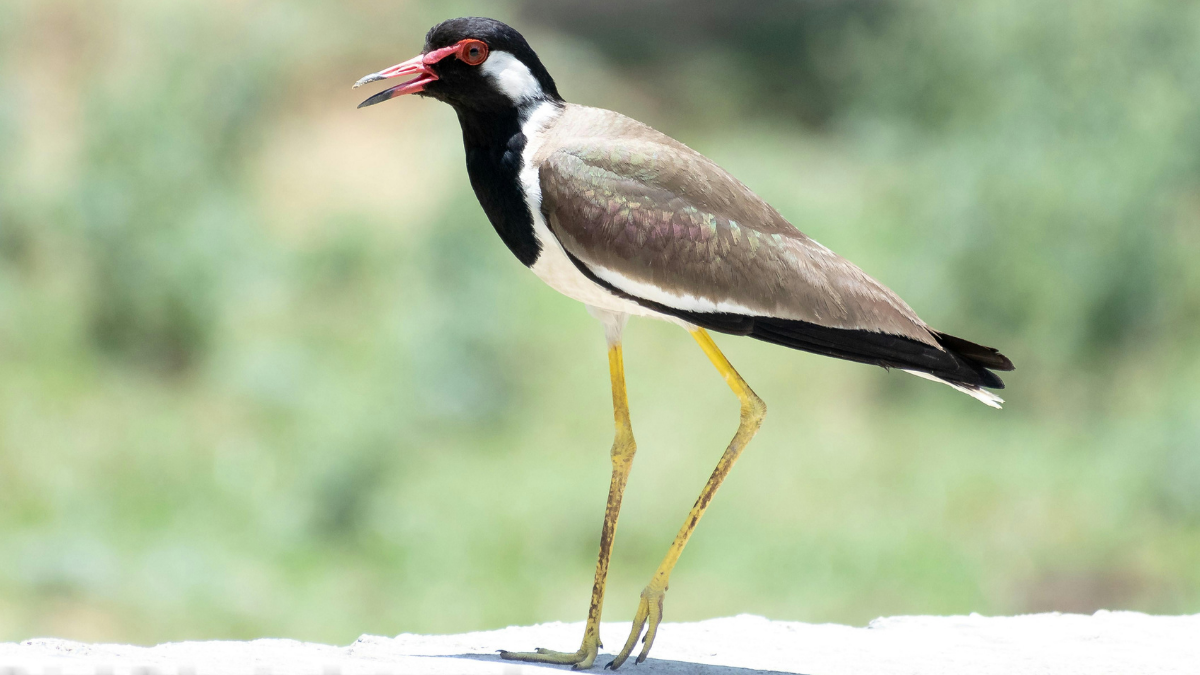
The red-wattled lapwing (Vanellus indicus) is a master of survival, a bird whose boldness and adaptability keep it thriving in landscapes that change faster than the seasons. Its long yellow legs carry it swiftly over open ground, head tilting from side to side as it scans for danger.
When a predator strays too close to its nest, it may stagger away in a theatrical broken-wing act, calling in alarm to lure the intruder off course. If that fails, it rises into the air, dive-bombing with a piercing cry and sometimes striking its foe in mid-flight.

In the searing heat of summer, it performs an even rarer trick: soaking its belly feathers in water and pressing them to its eggs, cooling them against the punishing sun. Courtship has its own drama, the male balancing precariously atop the female’s back, wings half-open as if rehearsing a daring performance. Such behaviors are not mere quirks, but finely tuned strategies honed over generations to keep this ground-nesting bird’s lineage alive.
For centuries, people across South Asia have looked to this bird as a harbinger of the monsoon. In Rajasthan, farmers still read the season in the lapwing’s nesting choice: higher ground means heavy rain ahead, low-lying nests point to drought. Science has confirmed what tradition long claimed, adding credibility to the old practice of using lapwing behavior to plan crops.
Folklore paints it in other roles too, a cosmic guardian holding up the sky in an old Hindi saying about impossible tasks, and in Kurdistan, a tireless messenger whose cries announce every shift in the land. Its voice, sharp and insistent, has worked its way into proverbs, rhymes, and daily life. Across languages, many of its names echo its call, showing how deeply intertwined its presence is with the human ear.
A bird at home in two worlds
This is a bird born to wetlands, riverbanks, and open scrub, yet it thrives in the company of people. It claims rooftops, gravel lots, even the gaps between railway tracks as nesting sites. City parks and golf courses provide insect-rich feeding grounds.
With these opportunities come new dangers: trampling hooves, spinning plow blades, prowling dogs and cats. Still, the lapwing’s silhouette is a familiar one across fields and sidewalks, its cry cutting through the noise of human life. In some cities, residents grow accustomed to its nocturnal calls, learning to distinguish between its casual chatter and urgent alarms.

Across its range, the species is considered secure, though edge populations in Turkey and the Middle East teeter on the brink as wetlands vanish under concrete and reservoirs. Conservationists warn that climate change will bring new pressures, with longer heat waves and shifting rains, and that even the lapwing’s famed resilience may be tested.
Noise from human activity could mask its alarm calls, weakening the protective network those warnings provide to other creatures. Local declines have been linked to intensified farming and habitat loss, yet the bird’s adaptability gives conservationists hope.
Fierce parents, fearless defenders
Lapwing parents share the work of raising their young, trading shifts at the nest with precision. One broods the eggs while the other feeds or belly-soaks to keep the clutch cool.
The chicks emerge ready to run, their mottled down melting into the earth and stones. At the first hint of danger, they freeze, perfectly still and invisible, until a soft parental cluck calls them back. The adults will confront anything they see as a threat, from crows to cattle, wings spread and voices raised until the danger retreats.


Observers have noted their fearlessness, recounting stories of lapwings chasing away birds of prey several times their size.
That voice, ringing and relentless, is why the lapwing is called the “did-he-do-it bird.” Farmers and herders claim to know its language, saying the tempo changes with the predator: a fox, a snake, a stray dog.
Whether under a full moon on a marsh or in the glare of a streetlamp by a park, its cry is the soundtrack of vigilance. Other wildlife often take advantage of its watchfulness, benefiting from the early warnings. In this way, the lapwing serves not only its own kind, but becomes a shared guardian of the landscape.
From monsoon prophet to rooftop resident, from fierce defender to sleepless sentinel, the red-wattled lapwing lives between the wild and the human. It is common, yes, but extraordinary in the ways it reads the world and makes it home.
Its story is one of adaptation, cultural resonance, and tireless watchfulness, a reminder that some guardians keep watch long after the rest have fallen silent.
Leave a comment