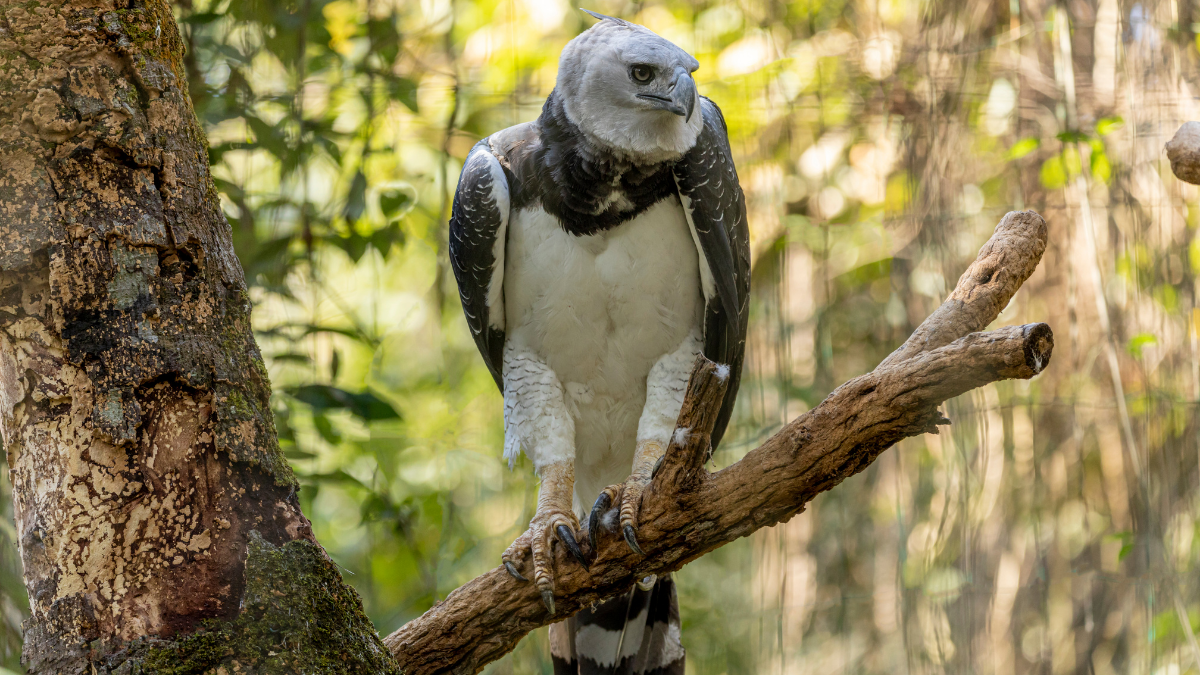
The forest near the Kourou River in French Guiana had fallen quiet, save for the hush of wind through canopy leaves. It was October 2023. A group of birdwatchers, guided by a local ecotourism camp, had set out on a jungle trail toward a natural bathing pool. Somewhere overhead, a harpy eagle watched.
They spotted the bird perched just 20 feet up, resting on a thick branch. It was a female, larger than any hawk most people would ever see, with talons the size of grizzly claws. She didn’t flee as they approached. She bobbed her head slowly and rhythmically—a movement researchers later said meant she was measuring distance.
One woman, a 29-year-old visitor from Europe, lingered to take photos. She paced up and down the trail, drawn in by the eagle’s raw presence. The rest of the group moved ahead. Moments later, the raptor launched.
The eagle slammed into her from behind, driving her to the ground. Her partner turned to find her curled on the forest floor, her head in her hands, the eagle standing on top of her. Its talons had pierced her scalp. The bird held firm, refusing to let go.
Only after the man stomped the eagle’s head into the dirt did it release. The woman was bleeding but conscious. The eagle flew off, seemingly unhurt, and called from the forest canopy.

She was evacuated to a hospital, treated for puncture wounds to her skull, and released later that week. She survived. But the encounter marked the first scientifically documented harpy eagle attack on a human in the wild.
The harpy eagle is no ordinary bird of prey. Females can weigh up to 20 pounds. Their talons are longer than a man’s fingers. They hunt monkeys, sloths, and opossums. They’ve been known to snatch animals like sloths, monkeys, and even porcupines from the canopy.
They don’t typically hunt humans. And yet, here was proof they could.
Harpy eagles have long lived in the fog between science and folklore. In Indigenous stories across the Amazon, these birds are feared as predators of children and the elderly. That fear hasn’t always been unfounded. Though rare, there are unverified accounts of eagles attacking people—often small or alone—sometimes requiring others to pry the bird off by force.
Why did the eagle attack?
It wasn’t random. Just before the incident, the group startled a paca—a large rodent—on the trail. Nearby, signs of a recent monkey kill were found. One theory is that the eagle had been feeding and was interrupted. Another is that she mistook the crouched woman, who was 5-foot-6 and weighed 114 pounds, for a primate. In a forest of prey, humans may not always stand apart.

These birds typically don’t act aggressively unless defending their food or nest. And that’s what’s puzzling: there was no nest nearby. Some researchers wonder if local guides may have been unintentionally feeding the eagle, causing her to associate humans with food.
Whether she was defending a meal or acting on instinct, the attack was real. And it echoes back through time. The Taung Child, a 2.5-million-year-old hominin fossil, bears talon marks eerily similar to those of modern eagles. Scientists believe it was killed and eaten by a raptor.
In that sense, the harpy eagle reminds us of something old. For millions of years, our ancestors looked up and saw danger in the trees. They learned to group together, to defend each other. In French Guiana, that instinct held.
“If you were by yourself,” said one researcher, “chances are the eagle would have won.”

So what happens now? Scientists are urging calm. Conservationists worry about overreaction. Harpy eagles are vulnerable. Deforestation, hunting, and habitat loss have already pushed them out of much of Central America. They survive today only in the largest tracts of unbroken forest.
They are not monsters. But they are wild.
And in the shadows of the Amazon canopy, they still hold the power to remind us of what it means to be prey.
Leave a comment